
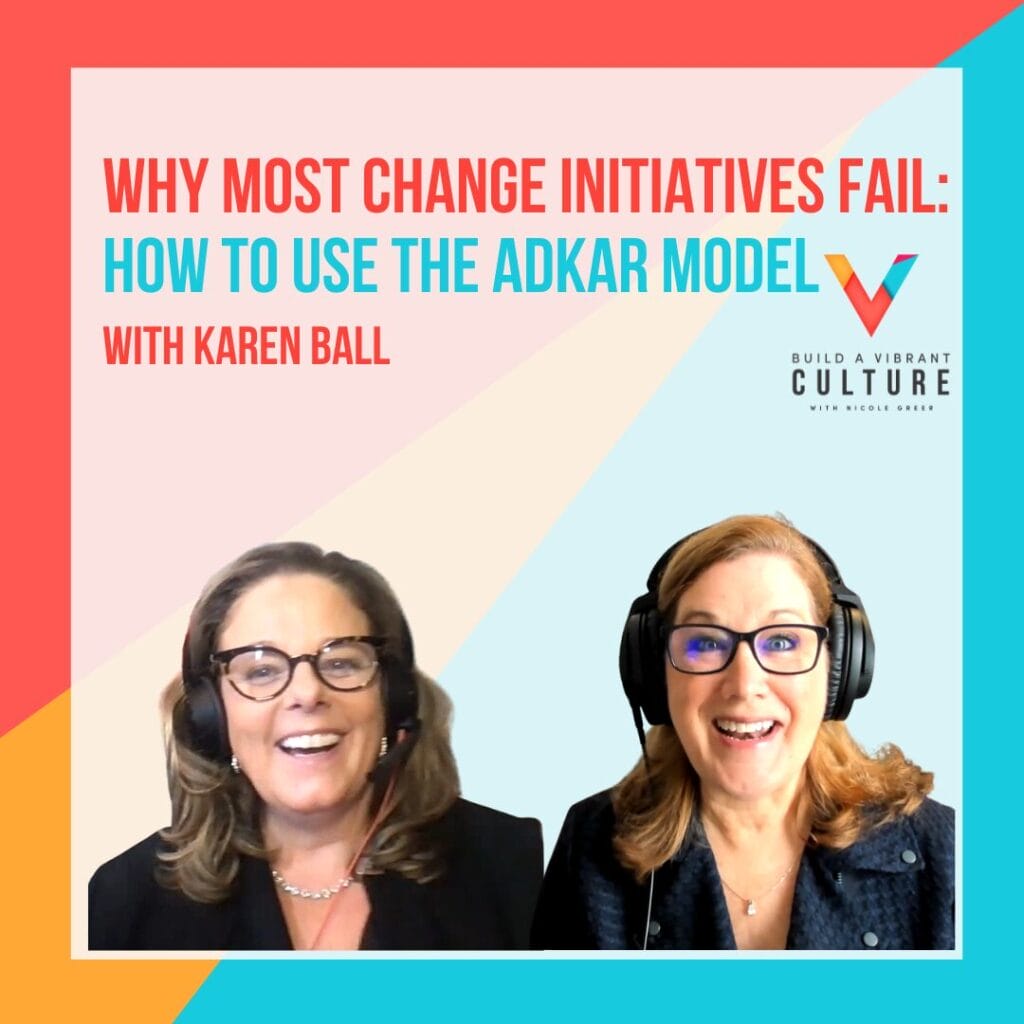
Most organizational change initiatives fail, even with a strong budget and a solid plan, because they lack the ADKAR Model.
In this episode of the Build a Vibrant Culture Podcast, Nicole Greer sits down with Karen Ball, senior fellow at Prosci and author of The ADKAR Advantage, to unpack the model that has shaped how thousands of organizations approach change management.
If you have never heard of the ADKAR Model, this conversation is your starting point. If you already know the acronym, Karen goes deeper into why organizational change so often stalls and what leaders can do differently to build change that actually lasts.
What Is the ADKAR Model?
ADKAR stands for Awareness, Desire, Knowledge, Ability, and Reinforcement. The model was developed in the 1990s by Jeff Hiatt, a Bell Laboratories engineer who studied patterns of change across roughly 700 organizations to understand why some initiatives succeeded while others fell apart.
What Hiatt discovered reshaped how the industry thinks about organizational change. Success was not driven by the activities that surround change, such as communication plans or training sessions. It was driven by how well each individual person moved through their own change journey. As Karen explains, there is no such thing as collective change. There are only the combined outcomes of every individual change happening at once.
Each letter in ADKAR represents an outcome a person must reach:
- Awareness of why the change is happening
- Desire to participate and support the change
- Knowledge of how to change
- Ability to implement new skills and behaviors
- Reinforcement to make the change stick
Karen points out that reinforcement is the piece most organizations skip. Without it, people naturally drift back to old habits, especially if performance metrics and rewards have not changed along with the process.
How One Person Makes a Change
A theme throughout the conversation is that organizational change management starts at the individual level. Karen shares several stories from her book, including one about a man named Graham who used the ADKAR model to teach himself to swim as an adult, and a mother who helped her son build healthier eating habits by connecting the change to his own motivation to perform better in sports.
These stories illustrate a core principle of the ADKAR model: awareness alone does not create change. A person has to choose to participate, build real knowledge, develop the ability to apply it, and receive reinforcement that helps the change hold over time.
Scaling ADKAR From Individual to Organizational Change
Once a leader understands how one person moves through change, that same framework can scale to a team, a department, or an entire company. Karen walks through an example of a 25-person customer service team adopting new software. Each person on that team has a different starting point, concerns, and pace through the ADKAR journey.
This is where people managers play a critical role in leadership and business outcomes. Instead of a blanket “everyone just adapt” approach, effective leaders identify where each team member is in their ADKAR journey and respond accordingly. Someone worried about losing their subject-matter expert status might need accelerated training and a clear new role, rather than feeling replaced.
Why Sponsorship Is the Number One Indicator of Successful Change
According to more than 25 years of Prosci research, active and visible sponsorship is consistently the strongest predictor of whether a change initiative succeeds. Karen breaks this down into what she calls the ABCs of sponsorship: leaders need to be active and visible, build coalitions of support, and communicate directly with the people affected by the change.
Karen shares an example from a pharmaceutical company transitioning to an open office space. The three leaders whose teams were moving into the new layout gave up their private offices first and sat in the open space before anyone else did. That visible action signaled to employees that the change was real and that the leadership team was fully behind it.
This kind of sponsorship matters just as much in leadership development and team communication as it does in large technology rollouts. Employees watch what leaders do far more closely than what they say.
Building a Culture That Is Good at Change
The final part of Karen’s book addresses how organizations build change capability as part of their culture, not just as a one-time project skill. Prosci uses a five-level maturity model, ranging from ad hoc or absent change management to change fully embedded in an organization’s DNA.
Karen’s advice for leaders looking to build this muscle: assess where your organization currently stands, identify the knowledge and mindset shifts your people need, and make change management part of how projects are planned from the start rather than an afterthought.
Key Takeaways for Leaders
- Change management succeeds or fails at the individual level, not the organizational level
- Reinforcement is the most commonly skipped step, and the one that makes change last
- Active, visible sponsorship is the single strongest predictor of successful change
- Building change capability is an ongoing part of organizational culture, not a one-time initiative
Karen Ball’s insights offer a practical framework for any leader working through business culture shifts, team communication challenges, or large-scale organizational change. Understanding the ADKAR model gives leaders a clear lens for knowing what to do and when to do it.
Connect With Karen Ball
Buy her book: https://a.co/d/dfEdiVs
LinkedIn: https://www.linkedin.com/in/karenball26/
Start Building Your Own Vibrant Culture
Explore Nicole Greer’s Training and Coaching Catalog to bring these strategies to your organization.
Interested in booking Nicole to speak or provide training on leadership and organizational change? Download the Speaker Kit or reach out directly at [email protected].
Connect with Nicole Greer on LinkedIn.

