
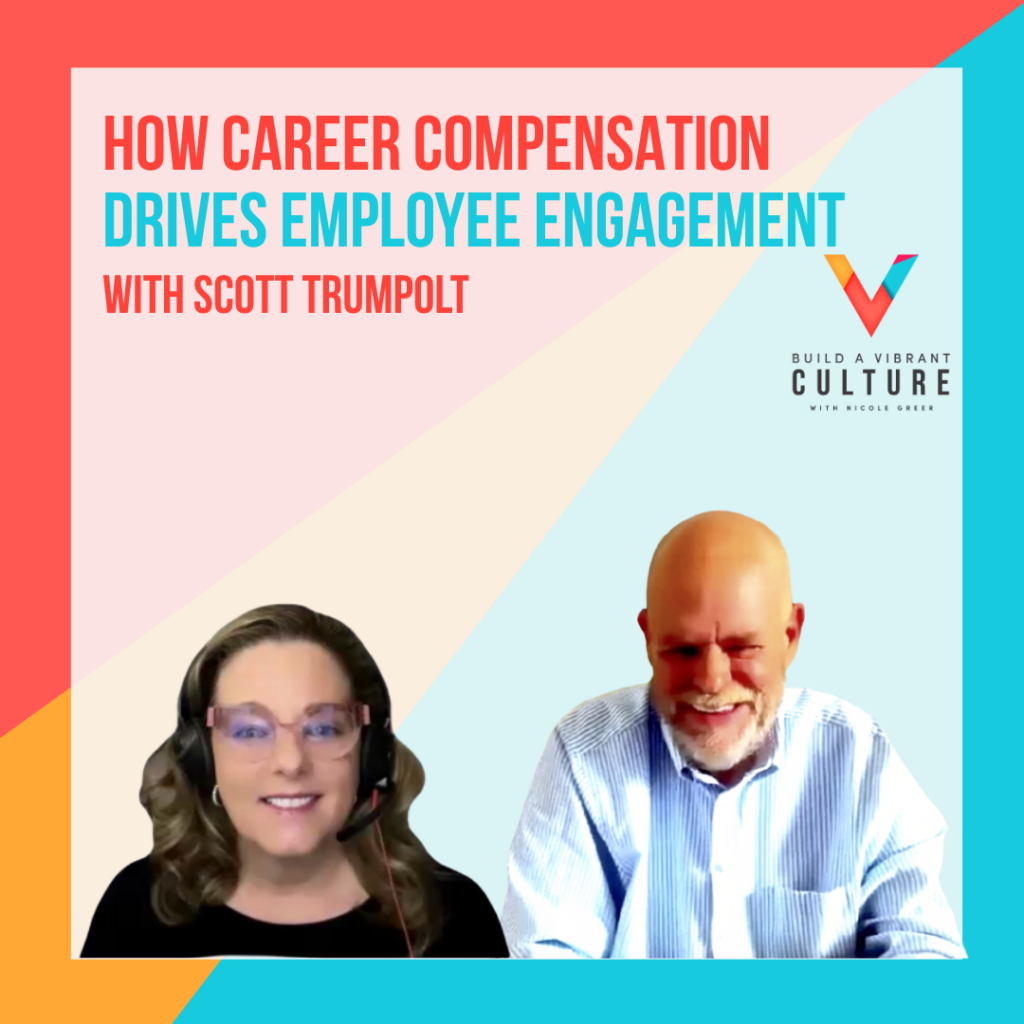
Career compensation is the missing link between pay and employee engagement. Most organizations still treat compensation as a once-a-year transaction: Here’s your raise, see you next year. On this episode of the Build a Vibrant Culture Podcast, Nicole Greer welcomes back compensation expert Scott Trumpolt, author of The Transparency of Compensation: The Employee Engagement Response, to explain how pay transparency and career-based pay conversations build trust, keep great people, and strengthen your work culture.
Why Organizations Still Avoid Talking About Compensation
Scott has spent more than 30 years in compensation, first in corporate HR and now as an independent consultant. In his experience, the discomfort starts at the top. Senior leaders think strategically about most business issues, but they tend to view compensation through a tactical lens. The moment pay transparency comes up, they picture posting every salary for everyone to see. That isn’t what transparency means.
Meanwhile, managers (the real drivers of employee engagement) are rarely armed with the right tools. They get through the merit process, deliver a number, and move on. The result is a stilted conversation that leaves employees with more questions than answers. The good news? New pay transparency laws are pushing these issues into the open, where organizations can address them in a positive way.
Tactical vs. Strategic: The Shift to Career Compensation
Scott draws a simple line between the two. A job, the work you’re doing at any moment in time, is tactical. A career is strategic. Career compensation asks a bigger question: Where can this person go, and how will their pay grow as they get there?
Nicole shared a real example from a North Carolina fabrication company that struggled to hire welders. Together they built a pay path: Start with no welding skill but a great attitude and earn a starting rate; become proficient and earn more; then teach the person next to you and earn more again. Engagement soared, and one young man named Matt grew into the program’s trainer. That’s career compensation in action: Pay tied to skills, competencies, and increasing value to the business. (Want to build that kind of growth path for your team? Explore Nicole’s employee training catalog.)
What Pay Secrecy Costs Employee Engagement and Trust
“If something is done in secret, there’s usually something to hide,” Scott says. He quickly adds that most organizations aren’t hiding anything sinister. Leaders are busy, and they don’t want to encourage salary comparisons. But employees talk anyway.
The real cost of secrecy is that employees can’t connect the dots. Five people may hold the same job with very different experience and skills, and no one explains how any of them can grow their compensation over time. Scott’s point is clear: People will accept a decision more readily, even when they don’t fully agree with it, if they understand the process. Without that understanding, trust leaks out of your organizational culture like water through a hole in a bag.
Turning the Merit Conversation Into Career Compensation
Picture this: An employee hears the merit budget is 3%, then receives 2%. The manager says, “That’s what the budget allows.” Conversation over, and engagement drops.
Now imagine the manager has better tools. “You’ve been here five years. You’re a terrific performer, and you’re paid above the market for this role. You’re ready for the next step in your development, so let’s build a plan to get you there.” Same 2%, completely different outcome. Nicole offers a similar script for managers when someone asks for a raise: “I would love to give you a raise. Here’s what you need to do.” Then outline the competencies needed for the next level. Giving managers language like this is a core part of Nicole’s leadership training at Vibrant Culture.
Understanding Market-Based Pay and Why the Money Follows
Most companies use a market-based pay structure. The midpoint of a pay range typically reflects the 50th percentile of the market for that job. If the midpoint is $80,000 and a strong performer earns $90,000, they’re $10,000 above market. That isn’t a problem; it’s a signal that it’s time to talk about the next level, because a pay range isn’t infinite. Shifting from job pay to career compensation is key.
Nicole’s own career illustrates the point. While managing an apartment community at Summit Properties, she was asked to take on marketing for the entire Charlotte market. Her husband’s first question was, “How much are they going to pay you?” She hadn’t even asked. Scott’s response: She was becoming more valuable to the organization, and over time, the money follows the skills.
Career Architecture: The Path to Career Compensation
Career architecture classifies jobs against the market with greater precision. As Scott explains, there’s no such thing as simply a financial analyst. There are levels (intermediate, senior, expert), each with more scope, complexity, and pay. Moving up isn’t about years of service. It’s about growing your skills in a way that aligns with the business need. When managers can show employees that pathway, pay becomes a tool for leadership development and retention instead of a source of frustration.
Pay Transparency Laws and Getting Your House in Order
We’re living in what Scott calls the age of disclosure. Employees share their salaries online, and more states require posted pay ranges. Before training managers to have transparent conversations, Scott recommends reviewing your internal pay structure, looking for internal equity issues, and confirming your pay practices match your compensation philosophy.
The Compensation Speed Round
Nicole closed with a rapid-fire round. Salary posted in every job ad? Only as required by law. Counteroffers? A dangerous habit. Annual merit increases? Keep them, but enhance them. Unlimited PTO? It can be a trap and even discourage engagement. Inflated job titles? Hazardous. And if you want employees to trust your compensation system, Scott says you have to make it part of your culture.
CONNECT WITH SCOTT TRUMPOLT
Scott Trumpolt is an independent compensation consultant with more than 30 years of experience helping organizations build fair, transparent, and engaging pay practices. Pick up his book, The Transparency of Compensation: The Employee Engagement Response, on Amazon or his website, and connect with Scott here:
Website: https://hrcompensationconsulting.com/
LinkedIn: https://www.linkedin.com/in/scott-trumpolt-m-a-g-r-p-257a6b317/
Book: The Transparency of Compensation: The Employee Engagement Response https://hrcompensationconsulting.com/book/
BUILD YOUR VIBRANT CULTURE WITH NICOLE GREER
Learn more about Vibrant Culture and how Nicole Greer can help your team succeed.
Download the Speaker Packet: https://vibrantculture.com/speaker-kit-request/
Explore the Employee Training Catalog: https://vibrantculture.com/catalog-request/
Explore the TILT 365 Assessments (a great starting point for career development conversations): https://vibrantculture.com/product-category/tilt-365/

