
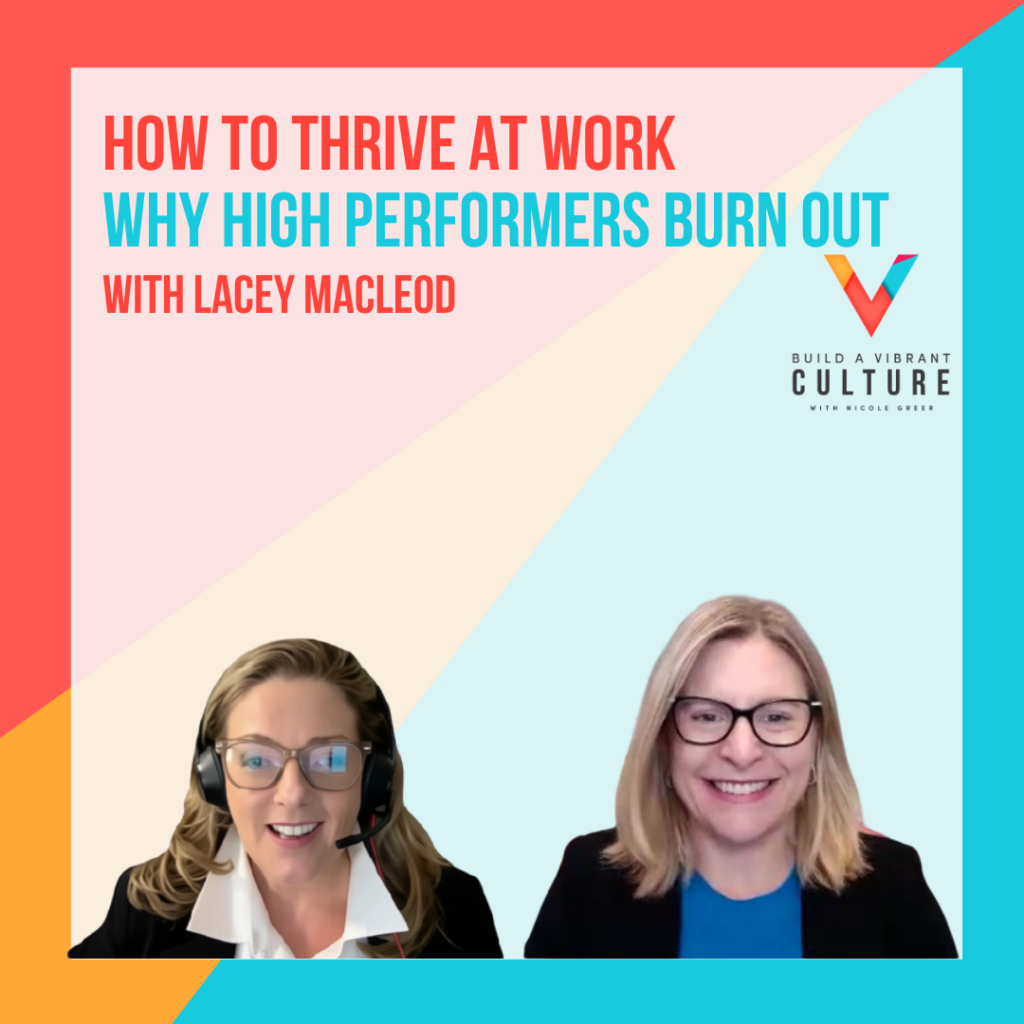
Want to thrive at work, not just survive until Friday? According to Lacey MacLeod, founder and CEO of Talent Uplifted, high performers are often the people closest to burnout, because the habits that made them successful eventually stop working. Lacey spent 15 years in corporate HR and leadership development. She joined Nicole Greer on the Build a Vibrant Culture Podcast to share the warning signs of burnout, the mindset shifts high-performing leaders need, and the simple daily practices that help people thrive at work and in life.
What It Means to Thrive at Work
Lacey’s philosophy is simple: When you thrive at work, you thrive in life, because it’s all one big life. So if you thrive at work, what does that look like? It’s not about happiness, and it’s not about productivity. Thriving means you feel both engaged and satisfied. You’re engaged in the work you’re doing, and you’re satisfied with what you put out at the end of most days and most weeks. No world is perfect, but you should have many more engaged and satisfied days than not.
Nicole shared a picture from her own master coach: At the end of a good day, it’s like your belly is full. You tried your best, you put your talents to work, and you got to do something you’re good at and enjoy.
The Burnout Warning Signs High Performers Miss
If you’ve ever finished a week thinking, “I worked my tail off, and I still have a million things to do,” that’s a sign something isn’t clicking. Lacey studies high performers, and she sees a familiar pattern. We call our best people “workhorses.” They get so much done with great results that we keep giving them more, until suddenly they’re no longer successful. Then we assume something is wrong with them, when in reality we’ve exhausted them.
The early signs of burnout include exhaustion that never goes away (a vacation or a massage doesn’t fix it) and being praised while your feedback goes unheard. And the biggest red flag? If you’ve ever sat in your car in the parking lot trying to talk yourself into walking into work, something isn’t right. This is a sign that you don’t thrive at work. The good news is that there are solutions, and you don’t have to live like that.
Why What Got You Here Won’t Keep You Thriving
High-performing leaders have to accept a hard truth: What made you successful isn’t what will keep you successful. Lacey calls it the law of diminishing returns. Too much rain becomes a flood. Too much sun becomes a drought. Working longer hours and being available to everyone can get results early in a career, but at higher levels of leadership those habits stop working.
Drawing on the Energy Leadership concept from the IPEC Coaching Institute, Lacey explains that our natural way of helping is “you win, I lose,” and at work, what we give up is our time. A better question is, “How can I help this person so that we both win?” Sometimes the most powerful thing you can do is not be available, so your team can think critically, ask a peer, and find the resources that have been there all along.
Leaders also need to think from their leader’s seat, not just their own. The biggest leadership jump, Lacey says, is from director to executive. It requires shifting from subject matter expert to strategic leader: Understanding results, gaps, and where the company is going, and leading through other people.
The Open Door Policy Myth and the Power of Time to Think
Nicole tells leaders all the time, you don’t have to be available all the time. Lacey also explained that the open door policy has nothing to do with doors. It means you can go to any leader in the organization with a problem without fear of retribution. It was never meant to be a revolving door, open and available 24 hours a day, 7 days a week.
Leaders need space to think. Lacey recommends A Minute to Think by Juliet Funt, and she found that the number one thing her coaching clients valued was simply space. Nicole shared how she told one credit union’s C-suite to try no meetings on Mondays and Fridays, using those “in days” for heads-down work. Lacey shared a client with no email before noon on Mondays. As she puts it, “If you created it, if you built it, if you wrote it, you can rewrite it.” If your managers need help building habits like these, explore Nicole’s employee training catalog.
Coaching Questions That Create Breakthroughs
A great coach listens between the lines and reflects the real problem back clearly and succinctly. Powerful coaching questions are open-ended, and Nicole added a tip from TILT 365’s Laser Coaching: Start almost every question with “what.” Lacey’s favorite questions include “What would happen if you didn’t go to that meeting?” and “What would you say to them if you brought it up?” She also invites clients to “give it to me raw,” because when we put more words to a problem, we often find the real one.
Every coaching conversation should end with an action, even if that action is to think or observe. Lacey once asked a CFO who dreaded people walking into her office to jot a sticky note each time it happened. The pattern? It was only one person.
Gratitude Beats Burnout
One of Lacey’s keynotes is called Gratitude Beats Burnout. Picture five matchsticks in a row, with the flame passing from one to the next. Gratitude is the third matchstick, the one that is put out, stopping the fire before it spreads. It won’t solve the root cause of burnout, but it creates the pause you need, and neuroscience shows that gratitude changes the chemistry in your brain so you can see the resources you already have.
The smaller and more specific, the better. For Lacey, it often starts with her morning coffee (made by her husband, Will), which quickly leads to gratitude for the people in her life. Her pro tip for teams: Start your meetings with gratitude. A 30-second round robin can turn tired faces into smiling, engaged ones, even during serious work.
The Three Priorities Rule
The habit that holds talented leaders back most often is failing to prioritize. Lacey tells clients they can never have more than three priorities in a day. And no, it’s not three for home and three for work. You’re one whole person. Get clear on your priorities, and it will solve 50% of your problems. Nicole added a key companion skill: Set expectations by asking, “When would be acceptable for me to get that to you?”
Priorities can change daily and weekly, because life changes. But when you choose them, you’re more likely to be satisfied with them, and being satisfied is part of what it means to thrive at work. As Lacey said in the rapid-fire round, a vibrant leader is someone who has clarity.
CONNECT WITH LACEY MACLEOD
Lacey MacLeod is the founder and CEO of Talent Uplifted. After 15 years in corporate HR, she became a certified coach dedicated to helping leaders and organizations create impactful, transformational results through coaching programs, workshop facilitation, and keynote presentations. Connect with Lacey here:
Website: https://talentuplifted.com
LinkedIn: https://www.linkedin.com/in/laceymacleod
Talent Uplifted on LinkedIn: https://www.linkedin.com/company/talentuplifted/
BUILD YOUR VIBRANT CULTURE WITH NICOLE GREER
Learn more about Vibrant Culture and how Nicole Greer can help your team succeed.
Download the Speaker Packet: https://vibrantculture.com/speaker-kit-request/
Explore the Employee Training Catalog: https://vibrantculture.com/catalog-request/
Explore the TILT 365 Assessments (a great way to uncover the strengths behind how your leaders think, prioritize, and coach): https://vibrantculture.com/product-category/tilt-365/

