
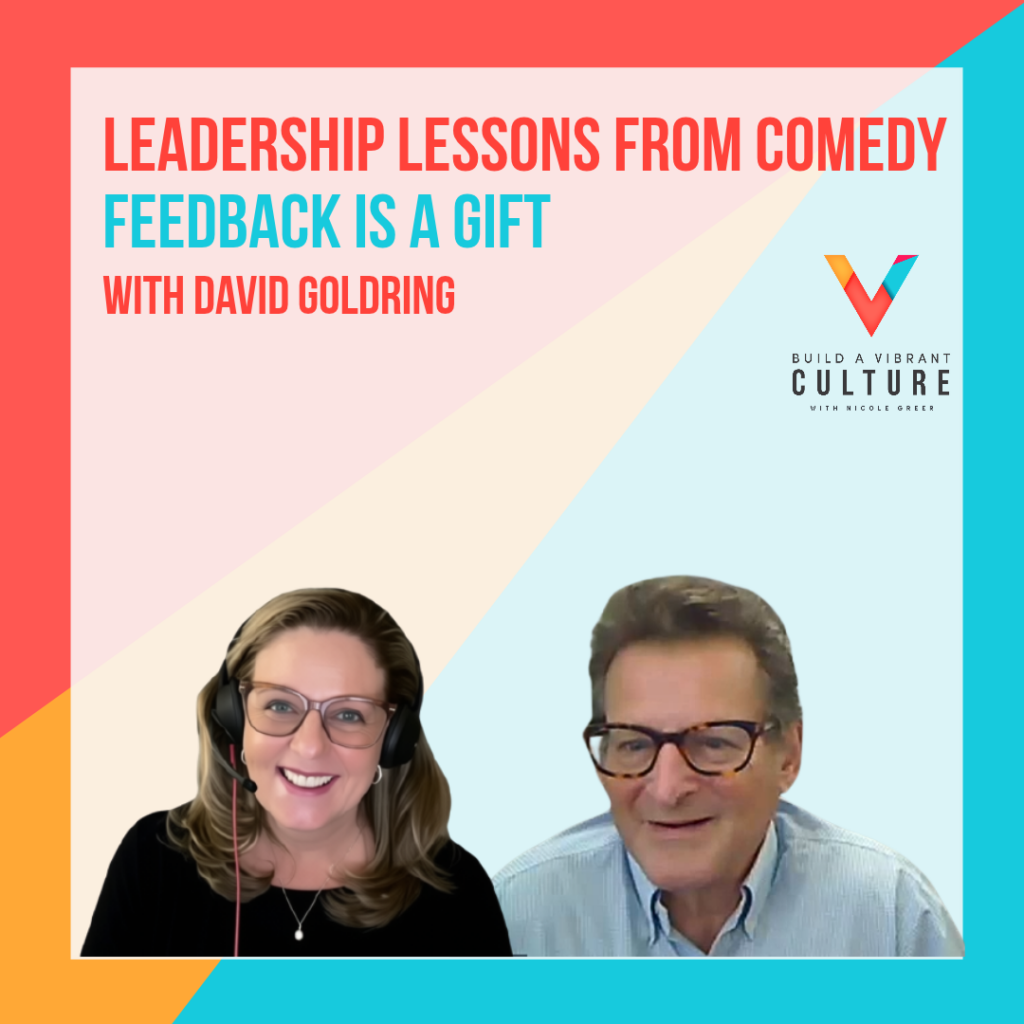
Leadership lessons from comedy might sound like the setup to a punchline, but for David Goldring, they’re the foundation of how he builds trust and leads a company. David is the chairman and CEO of Overseas Military Sales Corporation (OMSC), where he has spent more than three decades growing a global automotive business that serves U.S. military, diplomatic, and international communities. He’s also a working stand-up comedian and the author of the best seller Stand Up and Lead: Turning Comedy into Leadership. In this episode of the Build a Vibrant Culture Podcast, Nicole Greer and David talk about why feedback is a gift, how vulnerability builds trust, how leaders can read the room, and what it takes to lead a vibrant work culture.
From the Open Mic to the Boardroom: Leadership Is Influence
David’s first open mic went great. He invited all of his friends, and as he puts it, he could have read the phone book and they would have laughed. The second time, without his friends in the audience, he bombed. But he’d already felt what it was like to connect with a room, and he’s been chasing that feeling ever since.
The real lesson came in a tough club on New York’s Lower East Side, full of open mic comedians who had no interest in laughing. David realized that if he could connect with that crowd, build a relationship with them, and bring them along for the ride, he could do the same thing inside an organization. Influence is transferable. As Nicole pointed out, that also means leadership can be fun. You can get a positive charge from bringing people together around a shared goal.
Reading the Room: What Comedians Know That Leaders Miss
Before David steps on stage, he senses the energy in the room. Is the crowd mellow or rowdy? If the energy is low, he comes in big and loud to shift it. Too many leaders, he says, walk up to the podium and drone on without any regard for their audience.
Leaders can scan the room the same way a comedian does: body language, side conversations, people checking their phones. Play to the people who are with you, and most of the rest will follow. Some never will. During a strategic change, David tells his team, “If you can’t change the people, sometimes you have to change the people.” In comedy, you call security on a heckler who is ruining the show for everyone else. In an organization, protecting a vibrant culture sometimes means letting someone go.
Feedback Is a Gift (and Comedy Delivers It Instantly)
Nicole’s approach to leadership development starts with self-assessment, turning the mirror inward. Stand-up comedy is self-assessment every single night. David points to a Jerry Seinfeld story from his book: Seinfeld brings eight ideas to the stage, and the audience tells him which six work.
Because comedy delivers instant feedback, David treats failure, input, and criticism as gifts. In leadership, that means honoring the different voices on your team. You don’t have to agree with everyone, but good ideas can come from anywhere, and people should never be afraid to tell you, “Maybe we should do this instead.” A leader who is secure enough to accept feedback makes everyone better.
Using Humor to Build Psychological Safety
David often opens meetings with a short, real-life story (like getting cut off in New York City traffic) to lower the tension. A comedian does the same thing with an opening bit: It lets people’s guards down, shows a little vulnerability, and signals that it’s okay to relax. Nicole calls that the ultimate in psychological safety.
David is quick to add a caution: Know your audience. Humor that misses can become an HR issue. Even without jokes, leaders can start meetings with gratitude, appreciation, and a genuine check-in on how people are doing.
Vulnerable Leadership Is a Superpower, Not a Weakness
For David, healthy vulnerability means admitting you don’t have all the answers and tapping into the collective wisdom of your team. “Susie, help me out here. Tom, what do you think?” Leaders who act as if they know everything deprive themselves of their organization’s best thinking.
He learned this on stage. One night he flubbed a line, admitted it out loud, and the mistake got a bigger laugh than the joke. Owning the stumble connected him with the audience. In business, the same move works: Own the mistake, look at the data, learn from it, and move forward.
There is a line, though. Oversharing about a bad hair day or personal drama drains vulnerability of its power. And being vulnerable is not the same as being weak. A leader who falls apart over every small mishap won’t build trust, and people will stop bringing real problems forward. Nicole adds that everyone has bad days, but the story worth sharing is how you turned the day around.
The CEO Is the Chief Culture Leader
David describes his most important role as chief culture leader. At OMSC, the core values center on respect and earning trust in every single interaction. The customer isn’t owned by the manufacturer, the company, or the salesperson; that trust has to be earned again every time. David monitors customer feedback and the customer journey to make sure the team is living those values, not just posting them on a wall.
Leading by your North Star, he writes, leads to increased loyalty, higher morale, greater commitment, enhanced productivity, and higher retention. And as David told Nicole, it isn’t hard to do. There’s no magic. You just have to do it.
Soft Skills, Hard Results: Hear Before You Steer
Many leaders come from business programs that focus heavily on financial reporting and valuations. Financial literacy matters (Nicole recommends The Great Game of Business for helping everyone understand the numbers), but David argues the soft skills are the extra 10% that separates an average leader from an exceptional one: empathy, authenticity, listening, and connection.
Leaders love to jump straight to solving the problem. David’s alternative is to “hear before you steer.” Listen, ask for feedback, and understand the nuances first. Then give your team clarity on the why and the what, and let them own the how. As he tells his people, “I don’t need another David Goldring. I need another you.” That clarity carries extra weight at OMSC, where serving the military gives the whole team a deep sense of purpose.
Integrity, Training, and What You Measure
Integrity starts with hiring ethical people. From there, David says, alignment takes ongoing training, not a one-time event. Incentives drive behavior, so if you want people focused on the customer experience, that experience needs to show up in your KPIs and compensation. His favorite reminder: “Be careful what you measure, because it will improve.”
When Nicole asked him to finish the sentence “A vibrant leader always…”, David didn’t hesitate: “…is vulnerable and authentic.” Show empathy, listen to feedback, and be who you are. Trust follows, and once your people trust you, you can go places together. If you want to build those habits across your leadership team, explore Vibrant Culture’s leadership training programs.
CONNECT WITH DAVID GOLDRING
Website: davidjgoldring.com
Book: Stand Up and Lead: Turning Comedy into Leadership (paid link)
LinkedIn: David Goldring
Instagram: @djgfunny
Also mentioned: The Great Game of Business (paid link)
BUILD YOUR VIBRANT CULTURE WITH NICOLE GREER
Learn more about building a Vibrant Culture and how Nicole Greer can help your team succeed.
Download the Speaker Packet: https://vibrantculture.com/speaker-kit-request/
Explore the Employee Training Catalog: https://vibrantculture.com/catalog-request/
Explore the TILT 365 Assessments (build the self-awareness behind authentic, vulnerable leadership): https://vibrantculture.com/product-category/tilt-365/

