
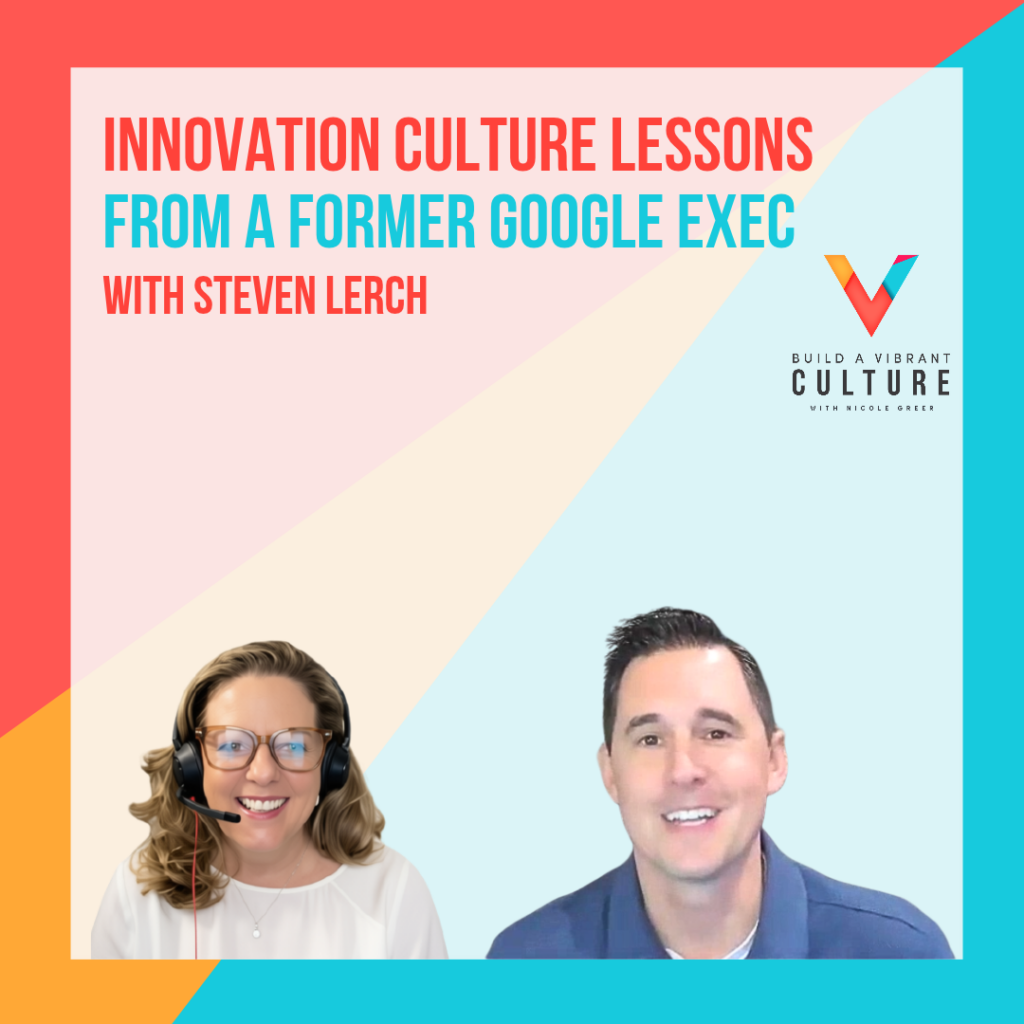
Innovation culture lessons don’t get much more credible than this: A former Google exec who spent a decade teaching thousands of Google employees how to innovate. And his biggest lesson? Innovation isn’t about technology. It’s about people. In this episode of the Build a Vibrant Culture Podcast, Nicole Greer sits down with Steve Lerch, best-selling author of INNOVATE. Igniting a Culture of Curiosity and Perpetual Improvement (https://link.amazon/B0jfKCRGR [paid link]), award-winning speaker, and former Google innovation evangelist. Together, they unpack why an innovation culture doesn’t happen by accident, and how leaders can spark curiosity at work by giving people permission to question the way things have always been done.
Innovation Culture Needs Structure
Most organizations romanticize innovation. We picture the brilliant idea that shows up out of nowhere. Steve believes that picture lets leaders off the hook. When innovation is treated as luck, no one builds the systems that make it happen.
His advice is simple: Treat innovation like accounting, legal, or manufacturing. It’s part of your business, so it deserves a time, a place, a budget, and a goal. Structure isn’t the enemy of creativity; it’s the springboard. Steve also points out that most innovations are small and boring. They live in processes and procedures, not flashy new products. Do 50 things 1% better and you can match the impact of one massive product change.
Innovation Culture Starts With Curiosity
What a Former Google Exec Learned
When Nicole asked Steve to describe the philosophy of innovation he taught at Google, he went straight to curiosity. In a world that changes this fast, none of us knows what’s possible. So the best course of action is to assume anything is possible, including a better way to do every task on your team’s plate.
That means nothing is ever finished. Not the best practices, not the forms, not the tools. Without that belief, leaders slide into the most dangerous phrase in business: “That’s the way we’ve always done it.”
How Terminal Contentment Stalls Innovation Culture
Steve calls the opposite of curiosity “terminal contentment.” It happens when successful organizations get comfortable, stop listening to feedback, and decide their changing customers are simply wrong.
His favorite example is the taxi industry. Uber launched around 2010 and needed years to catch up. In that time, taxi companies could have built apps, added phone payments, let riders review drivers, and shown cars on a map. They had the infrastructure. They just didn’t feel the need. Steve’s takeaway for leaders: The best time to innovate is when times are good, not when you’re already in trouble.
The Version One Habit for Perpetual Improvement
One of the most practical tools in the conversation is what Steve calls Version One. Imagine putting a small “V1” in the corner of everything at work: your expense report, your meeting agenda, even your strategic plan. That label tells everyone there’s supposed to be a version two.
Steve pairs this with brainstorming out loud. Instead of polishing ideas alone until they’re “ready,” teams get together and share half-baked thoughts right away. It’s messy and noisy, but one person’s rough idea is often exactly what sparks someone else’s breakthrough.
Innovation Culture With Psychological Safety
Celebrate the Bad Ideas Too
Asking for ideas only works when people feel safe answering honestly. Steve says complaining (with a purpose) is often the first step of innovation, because someone has to name the problem before anyone can solve it. That’s also why one habit kills innovation instantly: Leaders who say, “Don’t bring me a problem unless you have a solution.”
To keep curiosity alive, Steve recommends two moves. First, quickly adopt small, low-cost ideas, because the message the change sends is worth more than the change itself. Second, publicly celebrate the creative ideas you can’t use yet. When a leader thanks someone for a bold idea that won’t work right now, the team learns the goal isn’t to win. The goal is to participate.
Small Tweaks Can Lead to Big Results
For decades, Nerds candy brought in about $40 million a year. Then someone took the existing Nerds Rope, rolled it into a ball, and created Nerds Gummy Clusters, which Steve says now does roughly $800 million a year. No new flavors, no new formula. Just a small change that made the product easier to enjoy. Sometimes different is all you need.
Three Ways Leaders Can Build an Innovation Culture in 30 Days
Steve closed with three practical steps for any leader whose team has settled into the status quo:
1. Send the two-minute email. Tell your team you want their ideas, feedback, and questions, no matter how big, small, weird, or costly. Follow up a week later. Worst case, you’ve spent two minutes showing people you value them.
2. Run a Version One brainstorm. Give your team 10 minutes, sticky notes, and paper. Ask them to list everything that feels stuck on version one. They don’t need solutions; naming the problem is enough.
3. Notice your autopilot habits. Steve learned this after shoulder surgery, when his car rolled because he forgot to put it in park. We can’t question what we don’t notice, so identify the quick, automatic habits in your day and get curious about them.
As Steve put it in the rapid fire round, a vibrant culture is one where everyone participates.
CONNECT WITH STEVE LERCH
Learn more about Steve’s keynotes, workshops, and consulting at https://www.stevelerch.com/.
Connect with him on LinkedIn at https://www.linkedin.com/in/stevelerchspeaks/ or email [email protected].
Pick up his book, INNOVATE. Igniting a Culture of Curiosity and Perpetual Improvement, here: https://link.amazon/B0jfKCRGR (paid link).
BUILD YOUR VIBRANT CULTURE WITH NICOLE GREER
Learn more about Vibrant Culture and how Nicole Greer can help your team succeed. Whether you want to strengthen leadership communication, lead change with confidence, or build a workplace where people feel safe sharing ideas, Nicole’s leadership training and speaking programs bring these ideas to life.
Download the Speaker Packet: https://vibrantculture.com/speaker-kit-request/
Explore the Employee Training Catalog: https://vibrantculture.com/catalog-request/
Explore the TILT 365 Assessments: https://vibrantculture.com/product-category/tilt-365/

