
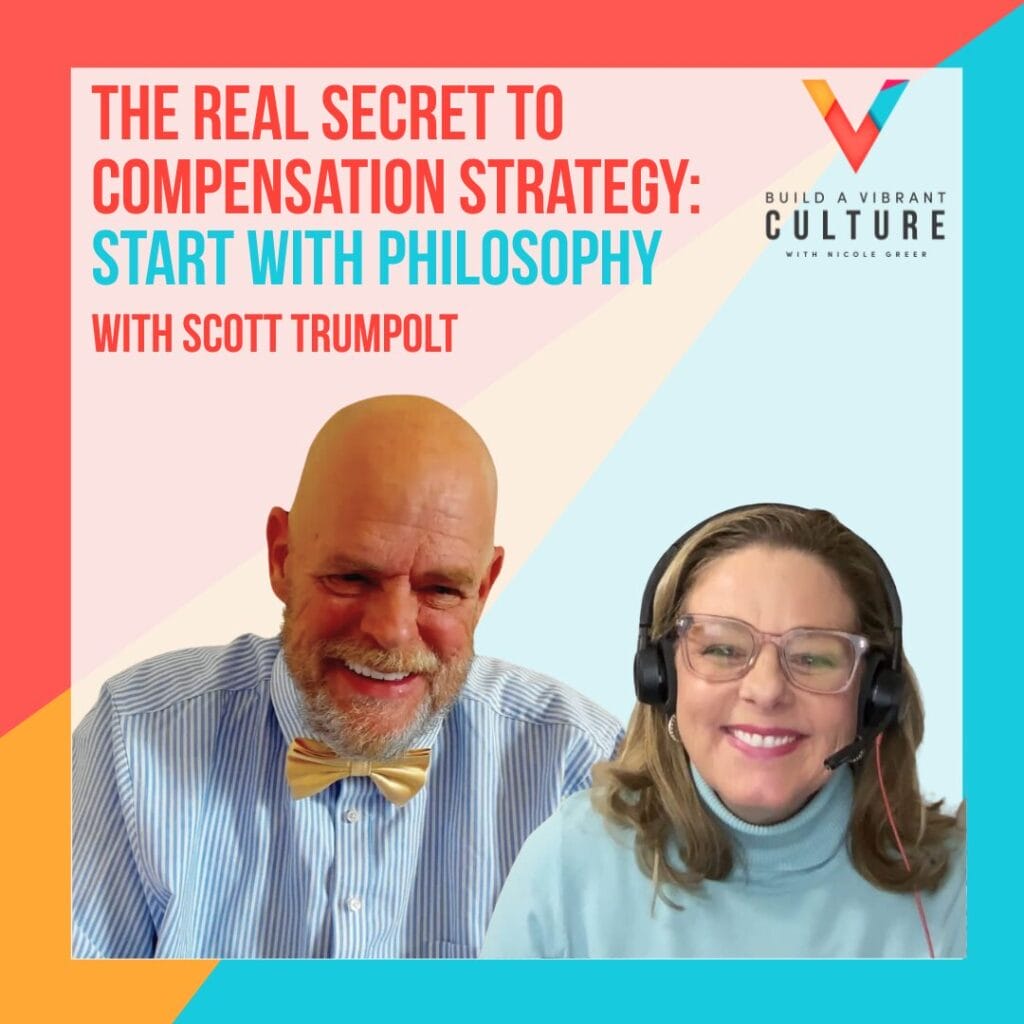
The #1 compensation mistake leaders keep making is depending on pay bands. Learn how philosophy, pay transparency, and performance-based rewards impact employee engagement, retention, and business success.
When most leaders hear the phrase compensation strategy, they immediately think of pay bands, salary ranges, and market data.
But according to Scott Trumpolt, that’s not where compensation strategy starts, and focusing there too early can actually create bigger problems down the road.
In a recent episode of the Build a Vibrant Culture Podcast, Nicole Greer sat down with Scott to unpack what compensation really means for organizations, and why so many companies are missing the mark.
Start With Philosophy, Not Pay
One of the biggest takeaways from the conversation is simple but often overlooked:
Compensation strategy starts with philosophy.
Before you build pay structures, define salary bands, or benchmark against the market, you need to answer a bigger question:
What do we believe about how people should be paid?
Do you want to:
- Pay above market to attract top talent?
- Stay competitive across the board?
- Offer lower base pay but higher incentives?
There’s no one “right” answer, but there is a right answer for your business.
Without a clear philosophy, compensation decisions become inconsistent. And when that happens, organizations often end up with what Nicole calls a “wonky situation” where pay varies widely with no clear logic behind it.
The Hidden Cost of “One-Off” Pay Decisions
Many organizations don’t realize they’re making compensation harder than it needs to be.
Instead of building a system, they make decisions one hire at a time.
That might feel easier in the moment, but over time it creates:
- Internal pay inequities
- Frustrated employees
- Difficulty explaining compensation decisions
- Increased turnover risk
Scott emphasizes the importance of having a defensible system, one that allows leaders to explain why someone is paid what they’re paid.
Because in today’s world of pay transparency, that question is coming whether you’re ready or not.
Why Promoting Top Performers Can Backfire
One of the most eye-opening parts of the conversation is a mistake many companies continue to make: Promoting high-performing individual contributors into management roles without preparing them.
Just because someone is great at their job doesn’t mean they’ll be great at leading people.
And when that happens:
- The employee struggles in a role they weren’t trained for
- Their pay may no longer align with market expectations
- The team suffers from a lack of leadership skills
Instead, Scott highlights the importance of dual career paths:
- A leadership track for people managers
- An expert track for high-level individual contributors
This allows organizations to reward expertise without forcing people into roles they’re not suited for.
The Problem With “Fair” Raises
Here’s a tough truth: giving everyone the same raise isn’t fair.
In fact, it can quietly damage employee engagement.
Many companies default to something like a 3% annual increase across the board. It feels simple and safe, but it ignores two critical factors:
- Performance
- Market positioning
Top performers, especially those being paid below market, should be recognized differently.
Scott suggests using compensation budgets more strategically:
- Higher increases for top performers below market
- Lower increases for employees already above market
This approach not only rewards performance but also helps correct pay imbalances over time.
Pay Transparency Is Changing the Game
With pay transparency laws expanding, employees now have more visibility than ever into compensation ranges.
However, seeing a salary range doesn’t answer the real question employees are asking:
Why am I paid where I am, and how do I grow?
This is where many organizations fall short.
They treat transparency as a compliance requirement instead of an opportunity for better communication and engagement.
The companies that are getting this right are:
- Training managers to have better compensation conversations
- Connecting pay directly to career development
- Helping employees understand how to grow into higher pay
Ultimately, transparency without context just creates confusion.
The Link Between Compensation and Culture
If you want to build a vibrant culture, compensation has to be part of the strategy.
Not just how much you pay, but how you talk about it, structure it, and connect it to growth.
Organizations with strong cultures:
- Prioritize employee engagement
- Create clear career paths
- Align compensation with business goals
- Communicate openly and consistently
As Scott points out, compensation and career development cannot operate in silos.
When they’re aligned, employees don’t just see a paycheck, they see a future.
Final Thought
Compensation isn’t just a numbers game.
It’s a leadership tool.
And when used intentionally, it can:
- Attract better talent
- Retain top performers
- Increase engagement
- Strengthen your culture
But it all starts with one question:
What’s your philosophy?
Get In Touch
Book by Scott Trumpolt:
The Defragmented Consultant
Scott’s company, TCDS, can be found here https://hrcompensationconsulting.com/
Ready to work on your company’s philosophy? Nicole is ready to coach your team: https://vibrantculture.com/catalog-request/
Need a speaker to breathe vibrancy into your event? Nicole has the ability to deliver energy, positivity, and honesty to your team: https://vibrantculture.com/speaker-kit-request/

