
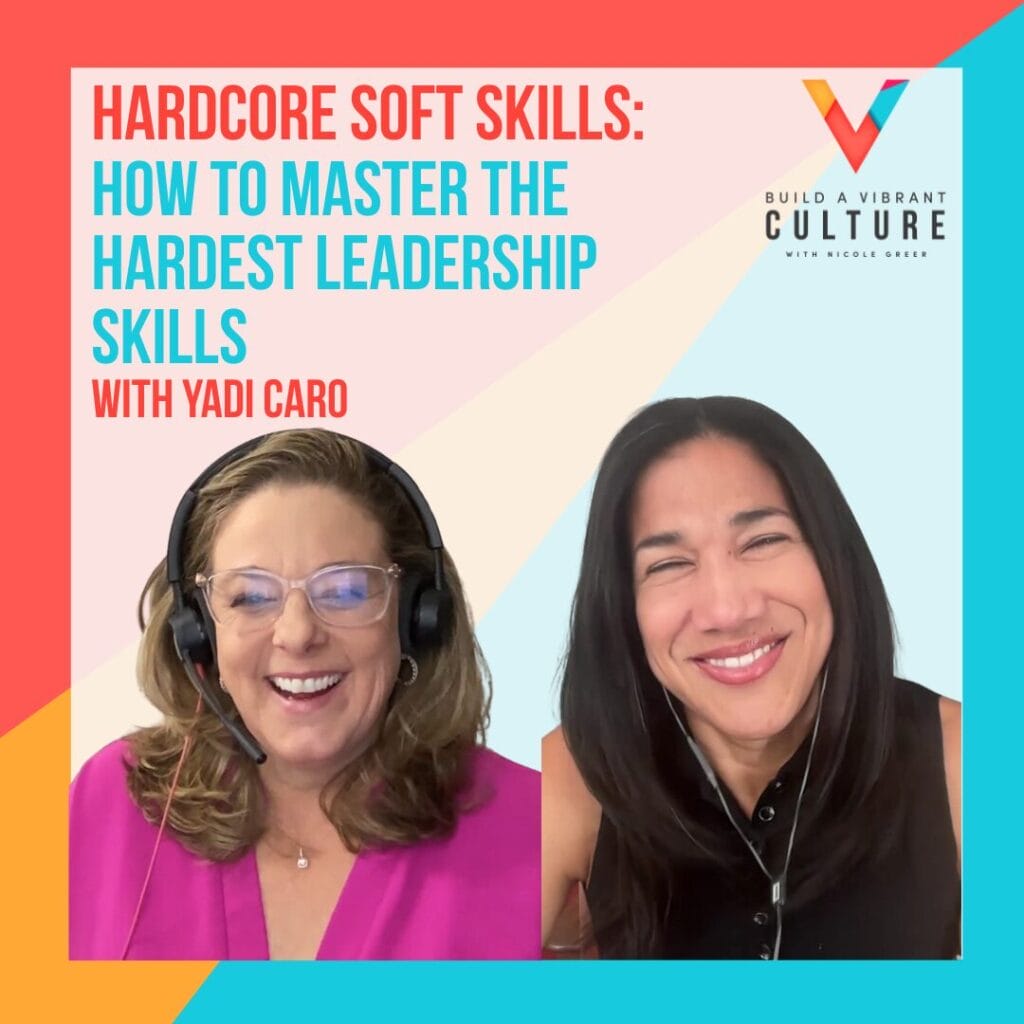
In this episode of the Build a Vibrant Culture podcast, Nicole Greer sits down with Yadi Caro, author of Hardcore Soft Skills: A Guide to Work with Humans, to explore why soft skills are the hardest and most important leadership skills. These skills create the best leaders, strongest teams, and healthiest workplace cultures. They include communication, collaboration, empathy, and leadership skills that help organizations thrive.
If you’re serious about building a stronger work culture and becoming the kind of leader people actually want to follow, this conversation is for you.
Yadi works with engineering and technology teams, military organizations, and leaders who want to improve the human side of business. Her message is simple but powerful: soft skills are not “soft” at all. In fact, they are some of the most difficult and most valuable skills professionals can develop.
When most people hear “soft skills,” they picture something easy, like pleasantries, small talk, and being nice. But what if the skills we’ve labeled “soft” are actually the most difficult and most important skills any leader can develop?
That’s the central argument of organizational psychologist and author Yadi Caro, whose book Hardcore Soft Skills: A Guide to Working with Humans flips the script on everything we thought we knew about leadership development. In a recent episode of the Build a Vibrant Culture podcast, Yadi joined me to break down why mastering communication, empathy, listening, and conflict management takes more dedication, practice, and courage than almost any technical skill.
What Makes Soft Skills “Hardcore”?
Yadi’s book opens with a simple but powerful insight: soft skills are not soft. They are, as Merriam-Webster defines “hardcore,” marked by persistent commitment, intensity, and dedication. Knowing how to have a difficult conversation, listen without interrupting, negotiate competing priorities, or navigate conflict without blowing up a relationship. These things take real work.
“When you want to have conversations in the middle of conflict,” Yadi explains, “you realize it’s quite difficult. Good communication, clear communication, negotiating, prioritizing. They require commitment every single day.”The title is intentional. Yadi wanted to challenge the assumption that these skills are secondary to technical expertise. In today’s AI-driven workplace, the ability to connect with, communicate with, and lead other humans is becoming more valuable, not less.
Step One: Connect (Start With Yourself)
Yadi structures her framework around five phases: Connect, Communicate, Collaborate, Create, and Correct. The foundation of all of it is self-awareness.
Before you can lead others, you have to understand yourself, your strengths, your motivations, what triggers you, and where you have room to grow. Yadi includes a full soft skills assessment in the book (pages 17–22) covering everything from listening and storytelling to conflict resolution, creativity, and diversity awareness. More importantly, she invites readers to define both their current self and their future self, and then map a path between the two.
“If I wanna be the person who walks into a room and speaks comfortably to a crowd,” she says, “I need to identify the skills that person has and start developing them today.”This kind of intentional growth requires what psychologist Carol Dweck calls a growth mindset, the belief that skills can be developed with practice and effort. It also requires humility. You don’t have to change your personality, Yadi emphasizes, but you do have to be honest about where you’re starting from.
The Art of Giving a Darn: Empathy at Work
One of the most impactful chapters in the book is titled How to Give a Darn About Others. It sounds simple. It isn’t.
Empathy in the workplace doesn’t mean being everyone’s therapist. It means understanding what motivates the people around you, what pressures they’re under, and what they actually need rather than what they say they need. Yadi uses the example of product development: if you want to build something people will use, you have to genuinely understand their pain points, not just assume you know the answer.
At work, this translates directly into stronger collaboration, fewer miscommunications, and better outcomes. “We’re so focused on processes,” Yadi says, “that we forget there are people making those processes happen.”
Communication: The Soft Skills Nobody Taught You
The second phase of Yadi’s framework is all about communication, and it covers far more ground than most leadership training programs touch.
Listening is the first big skill. Research shows that people speak at roughly 125 words per minute, but our brains can process over 400 words per minute. That gap is where distraction lives. The fix? Slow down, eliminate distractions, repeat back what you’ve heard, and ask open-ended questions. Yadi also introduces the concept of the strategic interruption, knowing when and how to redirect a conversation that has gone off track, while still making the other person feel heard.
Preventing misunderstandings is another critical communication skill that rarely gets enough attention. A huge number of workplace conflicts aren’t really conflicts at all. They’re the result of using the wrong communication method in the wrong situation. Urgent news? Send a quick message or pick up the phone. Complex project discussion? Don’t do it over chat. Conflict? Never, ever handle it via text. Establishing team communication norms up front (which channel for which purpose) can eliminate enormous amounts of friction.
Writing also gets its own chapter, and for good reason. In an age when it’s tempting to outsource all written communication to AI, Yadi argues that the act of writing is the act of thinking. It engages your brain, sharpens your comprehension, and develops critical thinking in ways that copy-pasting from ChatGPT simply doesn’t. The better your thinking, she notes, the better your prompts and the better your results, whether you’re writing yourself or working with AI.
Meetings, Saying No, and the sOFT Skills That Protect Your Time
Two of the most practically useful sections of the book tackle two of the biggest time-drains in organizational life: bad meetings and the inability to say no.
On meetings, Yadi recommends a simple but powerful shift: instead of a standard agenda, frame every meeting around questions. By the end of the meeting, those questions should be answered. This keeps things focused, reduces the “zombie status update” dynamic, and gives people a reason to actually pay attention. She also recommends limiting meeting size. Research suggests around seven people is the sweet spot for productive collaboration.
On saying no, Yadi is direct: if you don’t have a clear framework for your priorities, every request will feel equally urgent, and you’ll say yes to everything and burn out doing it. Her four W’s and one H framework helps: Who is asking? What is the request really about? Why is it coming up now? When is it needed? And how essential is it to what matters most? This framework makes it far easier to decline gracefully, redirect to better resources, or simply protect your time for the work that actually moves the needle.
Correct: Conflict, Feedback, and Getting Better Together
The final phase of Yadi’s framework is what she calls Correct, the ongoing practice of reflecting, adjusting, and improving as a team.
This includes conflict management, which Yadi reframes entirely. Conflict isn’t a sign that something is broken. It’s a sign that people care enough to disagree. Suppressing conflict doesn’t create harmony. It creates disengagement. Instead, Yadi recommends establishing team agreements upfront: how will we handle disagreement? Who makes the final call? What do we do when things get heated? Having that conversation before conflict happens makes it far less threatening when it does.
Feedback is the other cornerstone of this phase. Yadi’s advice is refreshingly direct: ask for permission before giving feedback, focus on the process rather than the person, and skip the sandwich method. Research consistently shows that people remember the last thing they hear, which means burying critical feedback between two pieces of praise often results in people walking away thinking everything is fine.Finally, drawing on her background in Agile, Yadi champions the retrospective: a regular, structured moment for teams to ask: What went well? What needs improvement? What do we start, stop, or continue? This practice, done consistently, is one of the most powerful tools available for building a high-performing, self-improving team.
The One Thing That Makes All of This Work: Commitment
Reading about soft skills won’t change anything. Neither will attending a single training or listening to one podcast episode.
What changes things is commitment. For example, pick one or two skills, practice them deliberately, and do it again next week. As Yadi says, “Teams that learn together are proven to be more effective.” A lunch-and-learn. A book club. A weekly retrospective. These aren’t luxuries. They’re how great work cultures get built.
How To Work With Us
Download the Speaker Packet (Book Nicole for your next event):
→ https://vibrantculture.com/speaker-kit-request/
Explore the Training & Coaching Catalog:
→ https://vibrantculture.com/catalog-request/
Connect with Yadi Caro: https://www.yadicaro.com/

