
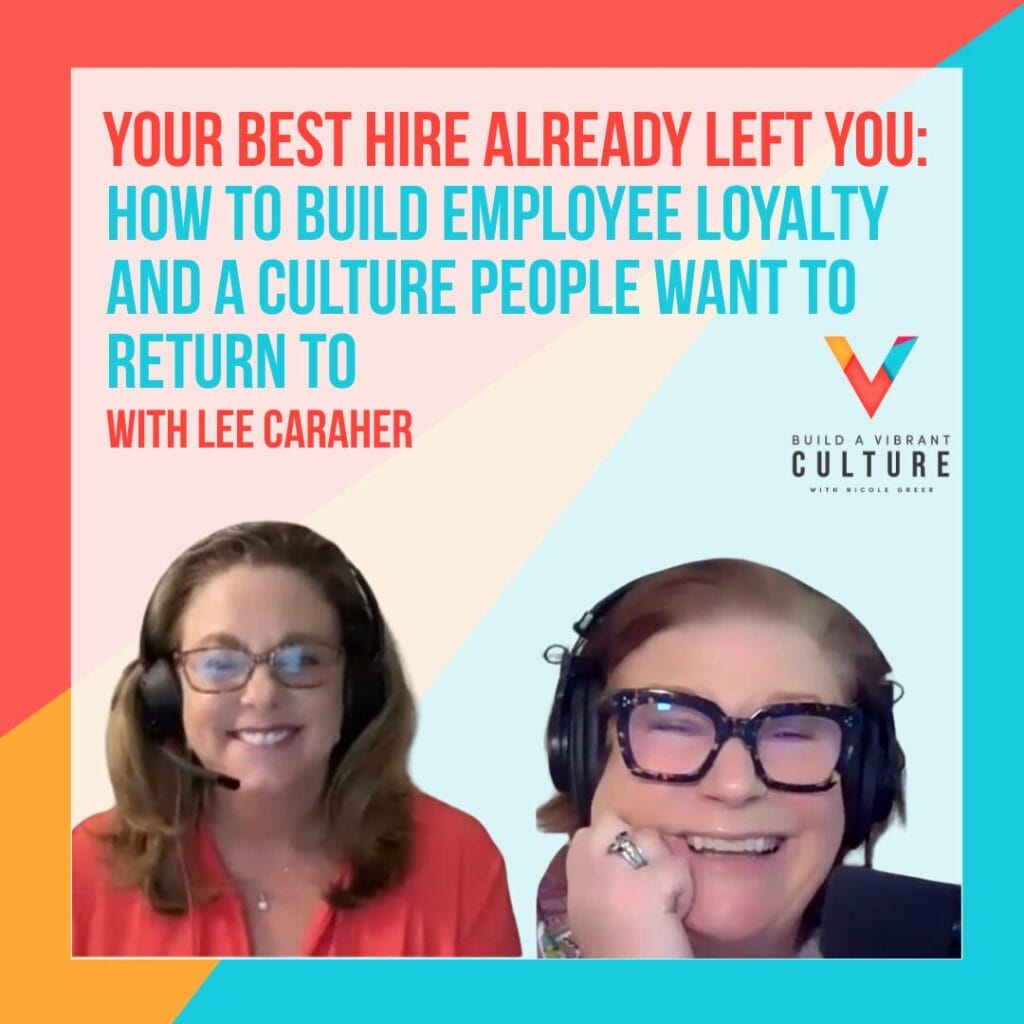
Your best hire already left you. In this
Want to improve work culture, build employee loyalty, and create a business that people actually want to come back to? In this episode of the Build a Vibrant Culture Podcast, Nicole Greer sat down with communication strategist and author Lee Caraher, CEO of Double Forte and Author of The Boomerang Principle, to learn how to build employee loyalty and a culture that people want to return to. Unpack the leadership strategies behind lasting employee engagement, strong organizational culture, and teams that perform at their highest level.
What Is the Boomerang Principle?
Most leaders dread turnover. Lee Caraher thinks they are looking at it backwards.
The Boomerang Principle is built on a simple idea: if former employees want to come back to your organization, you are winning. It means you let them go generously, they went out into the world, grew, and decided your company was worth returning to. And when they come back, they send a powerful message to everyone still on your team: the grass is not greener. We are watering our grass right here.
Beyond the cultural signal, the data makes a strong case. Standard onboarding takes close to a year for a new hire to be fully productive. For a returning employee, that ramp-up time drops to about four months. That is a significant productivity advantage, and it compounds when you consider the ripple effect: organizations with a genuine rehiring philosophy tend to retain good people longer across the board.
Rethinking What Loyalty Actually Means
Before you build employee loyalty, you must understand what loyalty is. One of the most clarifying moments in this conversation is when Lee reframes loyalty entirely.
Staying is not loyalty. Showing up and doing your job is not loyalty. That is employment. True loyalty, Lee argues, is when an employee who is no longer engaged tells you honestly and leaves on their own terms, rather than staying, disengaging, and dragging everyone around them down.
She makes the case that the most loyal thing an employee can do is leave well. And she backs it up with a story: a team member at Double Forte told Lee she wanted to become a nurse. Lee could not provide that path, but she could help. They restructured the woman’s role so she could stay, earn income, and get the credentials she needed to apply to nursing school. When she eventually left, she sent Double Forte six clients and five employees. No expectation. No quid pro quo. Just the result of being treated well on the way out.
That is what loyalty looks like in the modern workplace.
What Lee Tells Every New Hire in the First Five Minutes
Lee does something that surprises nearly every new employee: she tells them, in the first week, that she knows they are going to leave.
It is not defeatism. It is honesty. And it sets the tone for a relationship built on trust rather than obligation. She follows it with a commitment: Double Forte will support them, help them explore different things, and do whatever it can within the structure of the business to help them grow. They just have to share what they want.
This kind of straight talk is rare in leadership. It is also exactly the kind of communication that builds the psychological safety required for people to be honest with you before they hand in their notice.
How to Build a Culture of Value (Not Just Posters on the Wall)
Core values mean nothing if the worst behavior you allow contradicts them. Lee is direct on this point: you can say all the words you want, but what you tolerate is the culture you actually have.
At Double Forte, one of their core values is “we get sh*t done, well.” And they do not stop there. They define exactly what that looks like in behavior: accountability for your work, not leaving people hanging, solving problems first and then figuring out how to avoid them, and demonstrating willingness.
Nicole echoes this from her own culture work with organizations: core values need to be real, not aspirational. They need to describe how people actually behave on the best days, and then hold everyone accountable to that standard.
The same principle applies to vision and mission. Every team member should be able to draw a direct line from their individual role to the team’s contribution to the organization’s larger purpose. When that line is clear, people feel their work matters. When it is murky, you get disengagement, dropped balls, and the “I thought you were going to do it” problem.
The Oprah Effect: Why Personal Agency Changed Everything
Lee traces a significant shift in workforce expectations back to Oprah Winfrey. For over two decades, Oprah’s show delivered a consistent message to millions of people: know your values, align your life with them, and do not stay somewhere that works against your soul.
That message reshaped how people think about their careers, and it accelerated the movement toward values-driven work culture. Companies that still treat their mission statement as a framing exercise are behind. Today’s employees, especially younger ones, want to know what the company actually stands for and whether they can genuinely align with it.
Lee’s benchmark is 80 percent alignment. If your values and the company’s values overlap at 80 percent, you are in a life-enhancing situation. That alignment translates directly to productivity: teams that feel appreciated outperform those that do not by up to 30 percent.
Leading Younger Generations Without Losing Your Best People
Every generation complains about the next one. Lee points out that this is not new, and the complaints do not help anyone.
What does help is understanding what younger employees actually need: clarity on their role, honest feedback, real professional development, and the experience of being treated as a contributor rather than a subordinate. Lee’s approach with her own team: do it our way first, understand why the process exists, and then bring your ideas for improvement. Every improvement is welcome. But you cannot improve something you do not yet understand.
The shift from “because I said so” to “here is why, and here is how you fit” is not a generational concession. It is better leadership. And when you get it right with your youngest team members, everybody benefits.
Being a Good Place to Be From
Lee closes with a concept that is both simple and powerful: being a good place to be from.
When someone leaves your organization, what do they say about it? Does your name on their resume open doors or raise questions? Do people take Double Forte off their resume when they move on? They do not. And Lee has built a referral network on the back of that reputation.
The goal is not to keep people forever. The goal is to build something so worth being part of that people carry it with them proudly, send you their best contacts, and sometimes find their way back.
That is a vibrant culture.
About Lee Caraher
Lee Caraher is the CEO of Double Forte, a national communications agency, and the author of two books: “Millennials and Management” and “The Boomerang Principle.” She is a communication strategist known for her practical, straight-talking approach to leadership, culture, and team performance.
Find Lee at: double-forte.com and leecaraher.com
Work With Nicole Greer
Ready to build a culture your people want to return to?
🔹 Download the Speaker Kit: Book Nicole for your next event
🔹 Explore the Training and Coaching Catalog
Connect with Nicole on LinkedIn: https://www.linkedin.com/in/build-a-vibrant-culture-nicole-greer/
For speaking, training, or guest inquiries: [email protected]

