
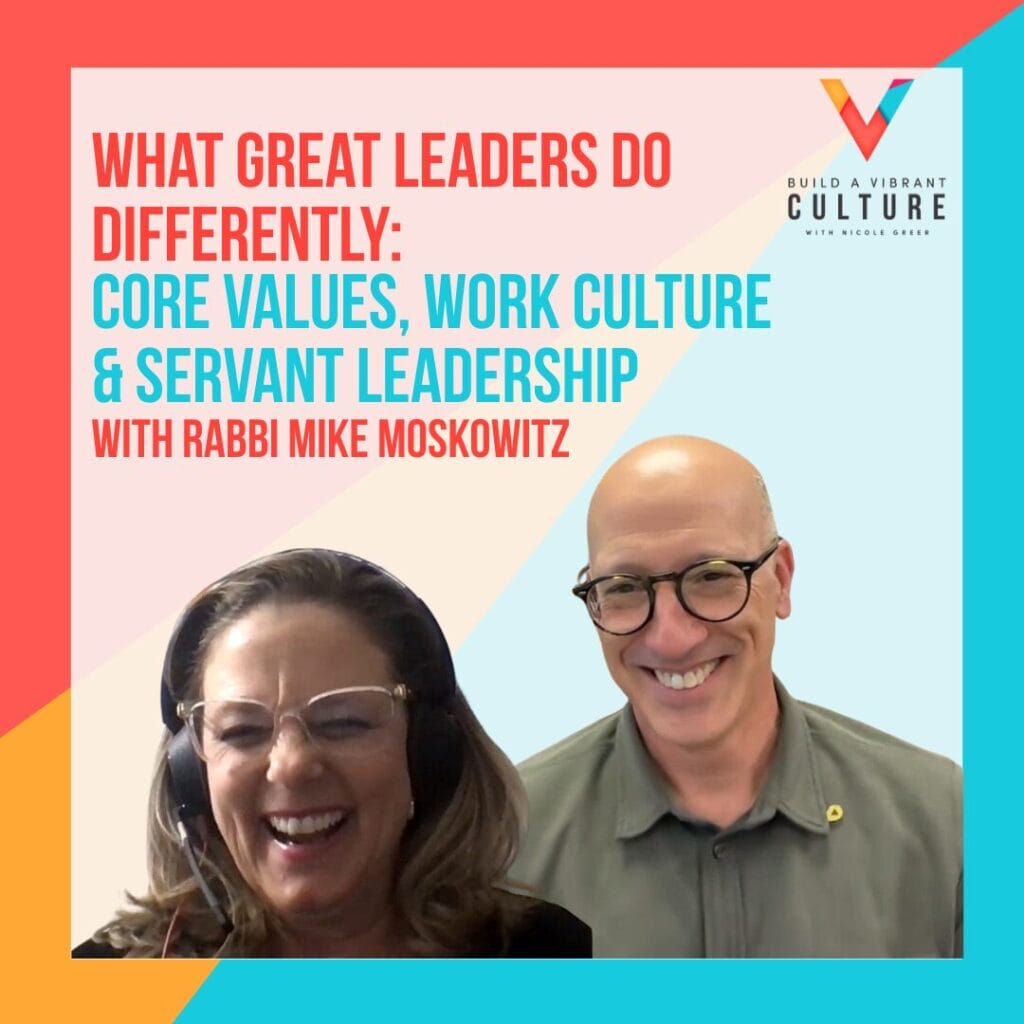
When you think about what great leaders do differently, who comes to mind? What is that difference? These leaders incorporate core values, work culture, and servant leadership; however, they don’t all come from a Fortune 500 boardroom. One in particular comes from a rabbi who has spent 30 years building one of the most thriving, values-driven communities in Detroit.
In this episode of the Build a Vibrant Culture Podcast, Nicole Greer sits down with Rabbi Mike Moskowitz of Temple Shir Shalom to explore how timeless principles of servant leadership, intentional core values, and community-building translate directly into stronger organizations, no matter your industry. Whether you lead a congregation, a corporation, or a small team, the frameworks Rabbi Mike shares are immediately applicable to how you build your work culture, communicate with your people, and lead with purpose.
From 30 Families to 900: What Intentional Culture Actually Looks Like
When Rabbi Mike arrived at Temple Shir Shalom in 1995, the congregation had around 500 families. Today it has grown to over 900. That kind of sustained growth happens through deliberate, values-driven leadership.
What’s striking is that Rabbi Mike didn’t just rely on inspiration or charisma to build this community. He implemented EOS (Entrepreneurial Operating System) / Traction. This is the same business framework used by thousands of companies to create a strategic 1-, 3-, and 10-year vision for his congregation.
“We realized we’ve grown more as a community and we have to sort of operate with a business head on,” Rabbi Mike shared, “but at the same time still keep that intimacy that we so treasure.”
This is a powerful lesson for any leader: Growth requires both heart and structure. You can have a deep mission and still need metrics, quarterly rocks, and a clear vision traction organizer (VTO) to get there.
The Core Values That Actually Mean Something
One of the biggest problems in organizational culture is hollow core values. These are the kind that have been sitting on a wall since 1994 collecting dust. Words like “excellence” and “integrity” that nobody can actually point to in their daily behavior.
Rabbi Mike and his team took a different approach. They spent a half day in deep conversation, then wordsmithed, set aside, and refined their values over time. The result? Four core values that are specific, memorable, and story-driven.
1. Dream Big and In Full Color
When Temple Shir Shalom started, there were only 30 families, and many doubted there was room for another congregation. The founding spirit was one of bold belief, trying things, not knowing exactly how they’d work, but believing in the vision anyway. “What’s the worst that can happen? It doesn’t work,” Rabbi Mike said.
Leadership takeaway: Great work culture gives people permission to dream. If your team is playing it safe all the time, your core values may be sending the wrong signal.
2. We Roll Up Our Sleeves
This value is about going above and beyond and doing whatever it takes, regardless of title. Rabbi Mike shared a story about showing up to flood-devastated homes in his congregation on a Friday afternoon with wine, candles, and challah because 44 families needed someone to show up. No committee. No delay. Just action.
“There’s no ‘oh my God, I’m the rabbi, I can’t do that,'” he said. “We all need to.”
Leadership takeaway: The leader who rolls up their sleeves, who fixes the metaphorical (and literal) toilet, earns a different kind of trust. Your team watches what you do, not just what you say.
3. We Save You a Seat
This is perhaps the most powerful of the four core values. It’s a commitment to radical inclusion that everyone belongs here, and it’s the community’s job to make that real. (Please check out the the episode called “How to Build an Inclusive Mindset at Work and at Home” with Justin Jones-Fosu)
Rabbi Mike told the story of a young girl named Shay, who had been turned away from other religious schools because of her physical, emotional, and mental challenges. Temple Shir Shalom said yes. They found what worked for her. They gave her a shadow. And she thrived. She could be found with her hands raised, singing with joy at every Sunday service.
“Everyone is better because of that,” Rabbi Mike reflected.
Shay passed away as a teenager due to a childhood heart transplant she had outgrown. But her presence still shapes how the congregation thinks about belonging.
Leadership takeaway: In business, we often focus on what’s wrong with someone instead of what’s right with them. “Save a seat” is a posture of possibility. This could apply to the engineer who doesn’t have the soft skills yet, the new hire who’s still finding their footing, or anyone in your organization or community that needs someone to pull up a chair.
4. We Dance in the Aisles
This value is about joy and the belief that work should feel alive, not like a grind. “If it feels like work, something’s not right,” Rabbi Mike said. But he was quick to add that this doesn’t mean avoiding hard things. Some of the most joyful moments come through the most difficult and even sad ones. For example, he was present for a bride who was grieving her father while celebrating one of the best days of her life.
Leadership takeaway: Joy isn’t the absence of difficulty. It’s the presence of meaning. Building a culture where people genuinely enjoy what they do and who they do it with is one of the most powerful competitive advantages a leader can cultivate.
Leading Through Crisis: What October 7th Taught a Community About Showing Up
When the news broke about the October 7th attacks in Israel, Rabbi Mike didn’t know what to do. He did know one thing: People needed to be together.
Without putting it on social media, he sent a simple email to his congregation. About 225 people showed up to the sanctuary that Sunday evening. They prayed, sang, and cried together. He sat in a circle with 45 high school students and just asked: What are you thinking? What do you know? What’s going on?
“I don’t have to have all the answers,” he said. “My congregation supports me as much as I support them.”
Leadership takeaway: In a crisis, your people don’t need you to have all the answers. They need you to show up, create space, and be honest about what you don’t know. That’s servant leadership in its most real form.
Ritual, Rhythm & Reverence in the Workplace
Nicole asked Rabbi Mike about the role of rituals in building culture, and his answer was beautifully practical.
He referenced a concept from Waldorf education: rhythm, ritual, and reverence. Children need these things. So do adults. So do organizations.
Rhythm gives structure to our days. Ritual gives us something to anchor to. Reverence reminds us we’re part of something bigger than ourselves.
For Rabbi Mike, this shows up through the weekly Sabbath, monthly cocktail services where he bartends and teaches, and Israel trips that forge bonds between congregants that last a lifetime.
Leadership takeaway: What rituals does your team have? Do you have genuine rhythms that create connection rather than the mandatory Monday morning meeting that everyone dreads? Team retreats. Learning lunches. A standing Friday reflection. Intentional ritual is one of the most underused tools in organizational culture.
Servant Leadership: The Model That Actually Works
When Nicole asked about servant leadership, Rabbi Mike’s answer was simple and profound: “Learn from everyone.”
He quoted a line from the Talmud, From all my students, I have learned. He shared how his professor spoke those same words to him. That idea shapes how he leads every day.
The best leaders, he argued, aren’t the ones who have all the answers. They’re the ones who create the conditions for others to succeed and then take genuine joy in watching them exceed expectations.
“I love when a 13-year-old does much more than they ever thought was possible,” he said about bar and bat mitzvahs.
Leadership takeaway: Invest in your people through one-on-ones, teaching, coaching, and development. Then get out of the way and watch them fly. That’s the whole game.
The Final Nugget: Learn for the Sake of Learning
Rabbi Mike’s parting thought was one every leader needs to hear.
He realized that for years, all his learning had been transactional. like studying for a sermon, preparing for a class, getting ready to teach. He had forgotten the joy of learning just to learn.
In Judaism this is called Torah lishmah, learning for its own sake, with no agenda.
“Take time to learn,” he said. “Whether it’s 15 minutes a week or an hour a week, just to learn, with no agenda. Things will happen from there.”
Leadership takeaway: The best leaders are lifelong learners. Not because it makes them more productive (though it will), but because curiosity keeps you alive, humble, and connected to something bigger than your to-do list.
Topics: work culture, business culture, organizational culture, servant leadership, core values, leadership and business, team communication, leadership development, belonging in the workplace, EOS traction, intentional culture-building
How To Connect With Us
Ready to build a stronger work culture, develop your leaders, and create an organization where people actually want to show up?
🔹 Download the Speaker Kit: Book Nicole for your next event 🔹 Explore the Training & Coaching Catalog: Leadership development that actually sticks
📩 For speaking, training, or coaching inquiries: [email protected] 🔗 Connect with Nicole on LinkedIn
Connect with Rabbi Mike Moskowitz

