
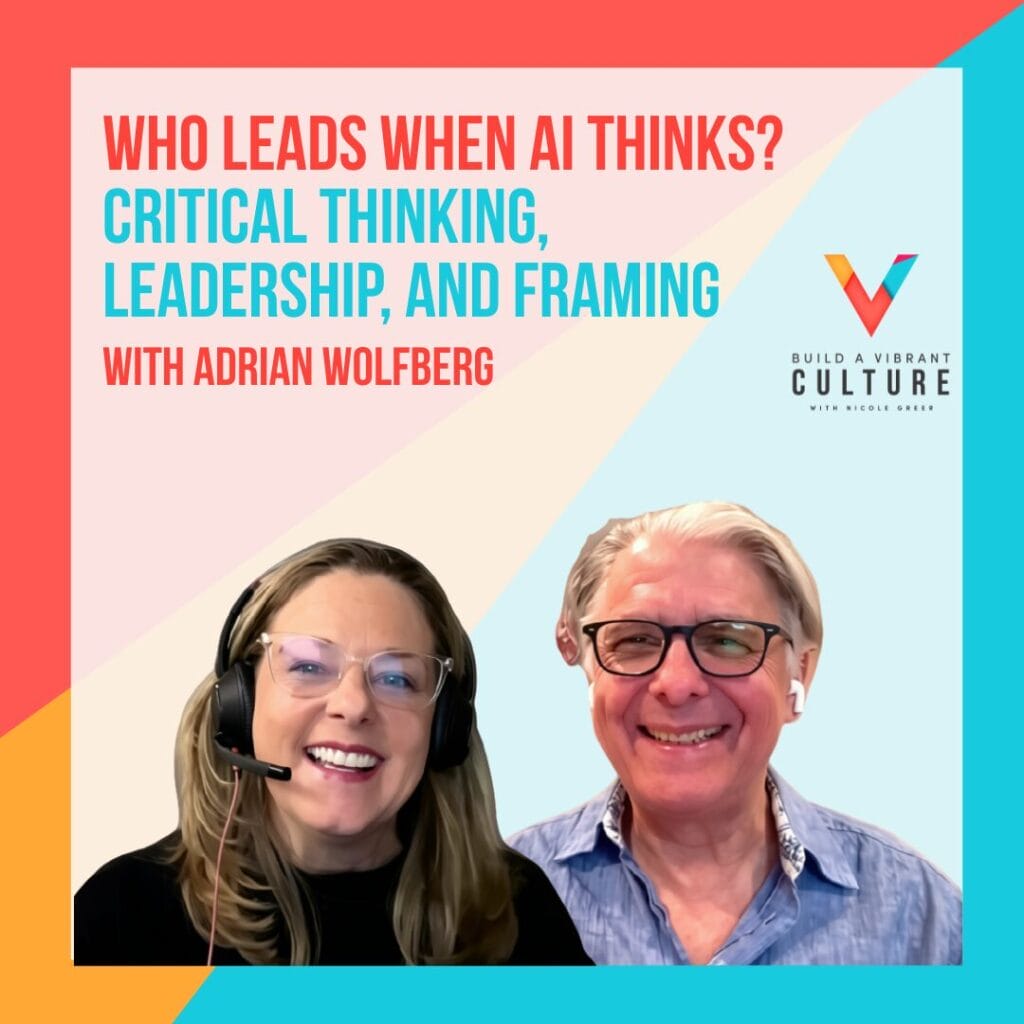
Who leads when AI thinks? Does AI remove critical thinking from leadership? Can leaders trust AI with the decisions that shape their organizations?
On this episode of the Build a Vibrant Culture Podcast, Nicole Greer welcomes Adrian Wolfberg, an organizational scientist, researcher, and former U.S. intelligence officer, to talk about leadership and business in the age of artificial intelligence. Adrian is the author of the new book Who Leads When AI Thinks? How Leaders Frame Decisions and Exercise Judgment. He offers a timely lens on organizational culture, decision-making, and the human skills that AI cannot replace.
Why Leaders Misunderstand AI
According to Adrian, the biggest mistake leaders make is treating AI as just another tool in the toolbox. Instead, he argues that AI represents something new: a relationship in which decision-making is shared between humans and machines for the first time. That shift changes everything about how leaders should approach work culture and business culture. It requires figuring out roles, responsibilities, and who holds final judgment on a decision, much like any relationship at work or at home.
Framing and Reframing: A Core Leadership Competency
Adrian introduces the idea of framing, which means defining the scope of a problem, understanding who is affected, and clarifying what is actually at stake before jumping to a solution. He is careful to note that framing is not a one-time exercise. As reality shifts, leaders must continually reframe the problem, a discipline he ties closely to reflection, a skill Nicole has long championed in her own leadership development work.
This concept connects directly to organizational culture. Building a culture that supports reframing means creating psychological safety, protecting time for reflection, and developing a shared vocabulary across the team so everyone, not just leadership, understands what is really going on.
Where AI Belongs, and Where Humans Must Lead
Adrian draws a clear line between well-structured, repeatable problems, which are ideal for AI integration, and unstructured, complex problems, such as a major supply chain disruption, which require heavy human involvement. He explains that strategic questions like where an organization is going or what its vision should be remain fundamentally human questions rooted in insight, relationships, and empathy, none of which AI can replicate.
Curiosity as the Most Underrated Leadership Skill
One of the most energizing parts of the conversation centers on curiosity. Adrian encourages young professionals to read widely, including novels and historical fiction, to strengthen imagination and empathy, skills he believes AI is least likely to ever replace. Nicole echoes this, sharing how she coaches leaders to ask better open-ended questions rather than settle for yes-or-no answers, a practice that builds trust and improves decision-making across a team.
The Mistake Leaders Will Regret
Looking ahead, Adrian predicts that over-dependence on AI and moving faster than teams can truly understand a problem will be among the leadership mistakes organizations look back on with regret. His advice for every CEO is simple but pointed: before greenlighting any AI project, leadership teams should be able to state the real problem they are solving in one sentence, along with the evidence that would prove them wrong.
A New Kind of Leadership Habit
This conversation is a strong reminder that leadership and business success in the AI era will depend less on adopting new technology and more on protecting distinctly human capabilities: judgment, curiosity, empathy, and the discipline of framing problems clearly. For leaders working to build a vibrant organizational culture, these are the habits worth investing in now.
Connect with Adrian Wolfberg
Buy the book: https://www.amazon.com/Who-Leads-When-Thinks-Decisions/dp/3032197163
LinkedIn: https://www.linkedin.com/in/adrianwolfberg
Ready to strengthen leadership and critical thinking on your team?
Explore Vibrant Culture’s training catalog or request a speaker kit to bring Nicole Greer’s insights to your next event.

