
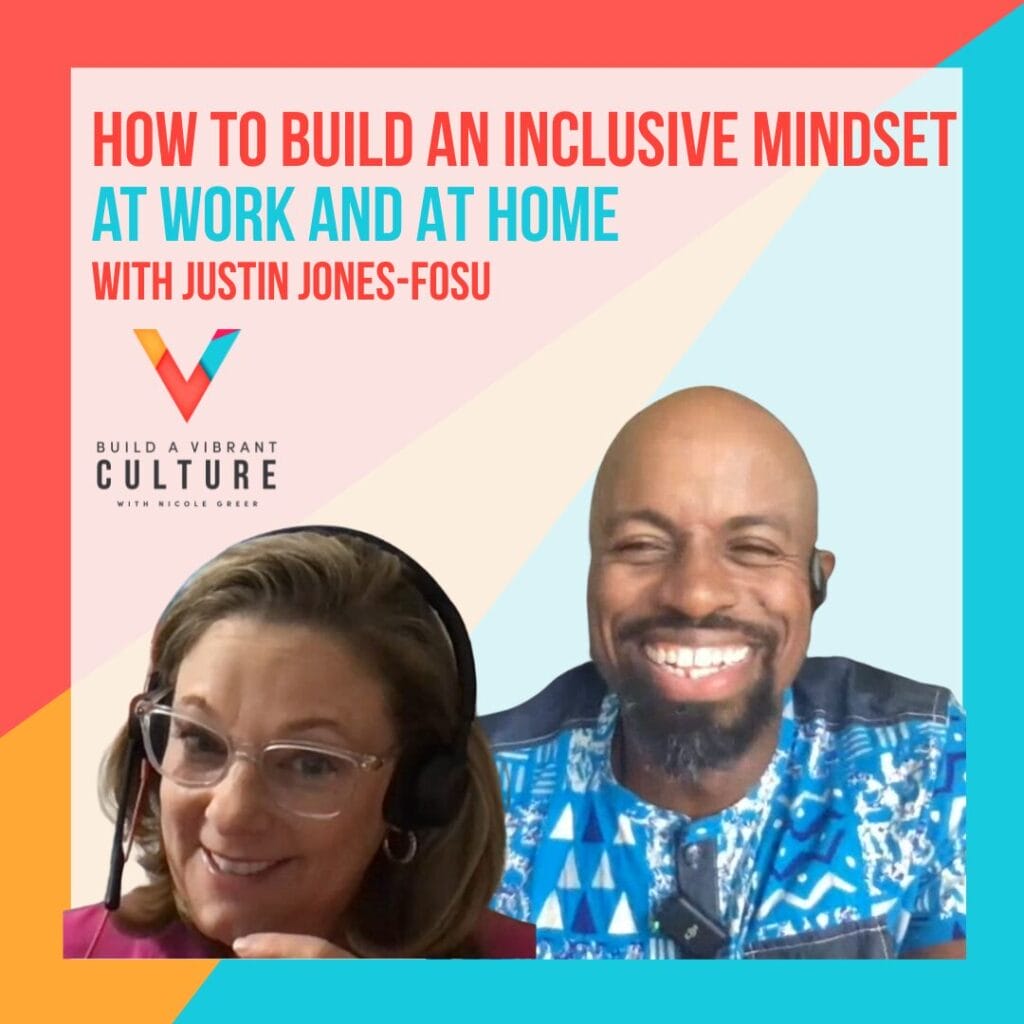
What if the biggest barrier to building a vibrant culture at work isn’t policy, training, or budget, but mindset?
In this episode of the Build a Vibrant Culture Podcast, Nicole Greer sits down with speaker, author, and inclusion strategist Justin Jones-Fosu to dig into the real meaning of diversity, the difference between an inclusive and exclusion mindset, and the practical strategies any leader can start using today. Justin is the author of The Inclusive Mindset: How to Cultivate Diversity in Your Everyday Life and I Respectfully Disagree: How to Have Difficult Conversations in a Divided World, and he brings the same warmth, honesty, and strategic precision to this conversation that he brings to every room he enters.
This episode is a re-release of one of our most impactful conversations. The content is just as relevant, and perhaps more urgent, than when it first aired.
What Type of Hugger Are You? (And Why It Matters for Inclusion)
Justin opens his book with a question that sounds playful but carries real weight: what kind of hugger are you? From the stiff-arm handshake to the full-on embrace, the way we physically show up mirrors how we approach unfamiliar ideas, people, and conversations.
His point is simple but profound: how we approach the conversation about diversity determines whether it will ever take root. If leaders treat inclusion like a box to check, arms crossed, waiting for training to end, it will never become part of how they lead. But when leaders lean in with genuine curiosity, the conversation stops feeling like an obligation and starts feeling like an opportunity.
The Inclusive-Exclusion Mindset Continuum
One of Justin’s most powerful frameworks is what he calls the inclusive-exclusion mindset continuum. At one end are the “I don’t want tos”, people who have no interest in engaging. Next are the “I have tos”, people who show up because they’re required to, arms crossed, waiting for it to be over. But Justin’s goal is to move people all the way to the “I get to” and “I love to”, leaders who actively seek out diverse perspectives because they understand it makes them better.
This isn’t just feel-good thinking. It’s a leadership performance issue. Organizations that stay stuck in the “I have to” zone are leaving enormous amounts of talent, creativity, and perspective on the table.
Redefining Diversity, It’s Not Just the “Big Three”
Here’s where Justin challenges something that even well-meaning leaders get wrong: diversity has been defined too narrowly for too long.
For years, the conversation defaulted to race, gender, and identity, what Justin calls “the big three.” But that framing has actually excluded whole groups of people and created a backlash that leaders are now navigating. Justin’s broader definition: diversity, at its simplest, is just difference. Economic diversity, religious diversity, political diversity, ability diversity, language diversity, every single person carries a unique combination of experiences that makes them inherently diverse.
As he puts it: when news anchors said in 2016 that they were leaving Iowa for “more diverse” states, they weren’t wrong that diversity looked different there, they were wrong to imply it didn’t exist. Every community is diverse. The question is: what type of diversity are we talking about?
This reframe matters for leaders because it changes the goal from “hitting a demographic target” to “genuinely understanding and leveraging what makes every person on your team unique.”
Growth Mindset and the Birthday Challenge
Justin connects the inclusive mindset directly to Carol Dweck’s research on growth mindset vs. fixed mindset, and illustrates the difference with a story about learning to ski at Vail in his mid-thirties while 6-year-olds whooshed past him on the slopes.
Fixed mindset people avoid things that make them look bad. They compare themselves to others, treat failure as evidence that they don’t belong, and stay in their comfort zone to protect their image. Growth mindset people understand that failure is just a data point, and that the only real competition is who they were yesterday.
To deliberately cultivate this mindset, Justin created what he calls the Birthday Challenge: every year on his birthday, he chooses one thing he’s never done before but has always considered. It’s led him to run a marathon, climb Mount Kilimanjaro, learn to sail, and yes, eventually become a confident skier. The framework is simple: uncomfortable experiences, done with intention, build the exact mental muscles that make inclusive leadership possible.
Practical Strategies Every Leader Can Use Today
This is where Justin’s value as a strategist really shines. He doesn’t just talk about inclusion, he gives leaders a repeatable system for practicing it.
1MC/W, One Meaningful Connection Per Week Block 15–20 minutes on your calendar each week to have a meaningful conversation with someone at work, in your community, or in your neighborhood. Not a status update, not a performance check-in, a real conversation where you ask about them. Can’t do weekly? Flip the “W” upside down and make it monthly. Either way, the accumulation compounds.
The Power of Three Most people listen to the “power of one”, they hear something, and immediately bring the conversation back to themselves. Justin’s challenge: ask three layers deep before redirecting. If someone mentions a great seafood restaurant, don’t immediately recommend your favorite. Ask: what made it great? What did you order? What would you go back for? Deep listening is how you learn what actually matters to the people around you.
The Circles of Grace Challenge Every six to twelve months, intentionally seek out an event, experience, or conversation that you either don’t know much about or that you actively disagree with, and go with only two questions: What did I learn about this? and What did I learn about myself? Justin has found that some circles of grace have completely changed his perspective. Others have simply confirmed what he already believed. But in both cases, he walked away with firsthand experience instead of assumptions.
The Pantera Story: What Belonging Actually Looks Like
Perhaps the most memorable moment in the conversation is Justin’s story from Lima, Peru. After finishing a workout, he walked past a group of young locals dancing in a circle. He wanted to join, but hesitated. He didn’t speak the language. He was from a different country. He was older. And, the real fear: what if they didn’t like his dancing?
He was about to walk away when one of the best dancers in the group, a man he later learned was named Pantera, stepped outside the circle and invited him in. Not with pressure, just with presence: Hey, where are you from? What’s your name? If you want to join, you can join. If you want to dance, you can dance.
Justin joined. He danced. They cheered.
What he realized watching the video later was that Pantera had modeled the entire inclusive mindset in one simple act: he left the circle where he held status, went to the person on the outside, asked about them, welcomed them in, and then invited them to show up as themselves, not to fit the mold of the circle.
That is what great leaders do. Not just welcoming people, but leaving the safety of their own circle to go get them.
Being “Invitable”, The Trait Leaders Often Overlook
There’s a flip side to welcoming others, and it’s one that Justin says doesn’t get nearly enough attention: being invitable.
If you’re constantly too busy to say yes, never showing up to the optional lunch, always finding a reason to skip the happy hour, you may be signaling (unintentionally) that you’re not open to connection. Justin learned this in his own neighborhood, where his primarily Indian neighbors repeatedly invited him to play volleyball and he repeatedly declined, until the day he finally said yes.
That one volleyball game was the beginning of real relationships. He learned their names. He learned their stories. The community he almost kept at arm’s length became one he genuinely belonged to.
The question for every leader: Are you being as invitable as you’re asking others to be?
Build Your Vibrant Culture, One Person at a Time
What makes this conversation so valuable for leaders isn’t that it introduces complex DEI frameworks. It’s that it brings inclusion back to something fundamentally human: curiosity, connection, and the willingness to step outside your comfort zone and meet people where they are.
Building a vibrant work culture doesn’t happen in a single training. It happens in the hallway conversation, the lunch invitation, the moment you decide to stay two more layers deep in someone’s story. It happens when leaders choose to be the Pantera in the room, leaving their circle to welcome someone in.
Connect With Justin Jones-Fosu
- 📘 The Inclusive Mindset: How to Cultivate Diversity in Your Everyday Life
- 📘 I Respectfully Disagree: How to Have Difficult Conversations in a Divided World
- Both available at https://workmeaningful.com/books/.
Work With Nicole Greer & Vibrant Culture
Ready to build a work culture where people thrive, communicate effectively, and do their best work?
🔹 Book Nicole to Speak at Your Next Event: vibrantculture.com/speaker-kit-request/
🔹 Explore Leadership Training & Coaching: vibrantculture.com/catalog-request/
🔹 Connect on LinkedIn: Nicole Greer
🔹 Speaking & Training Inquiries: [email protected]

