
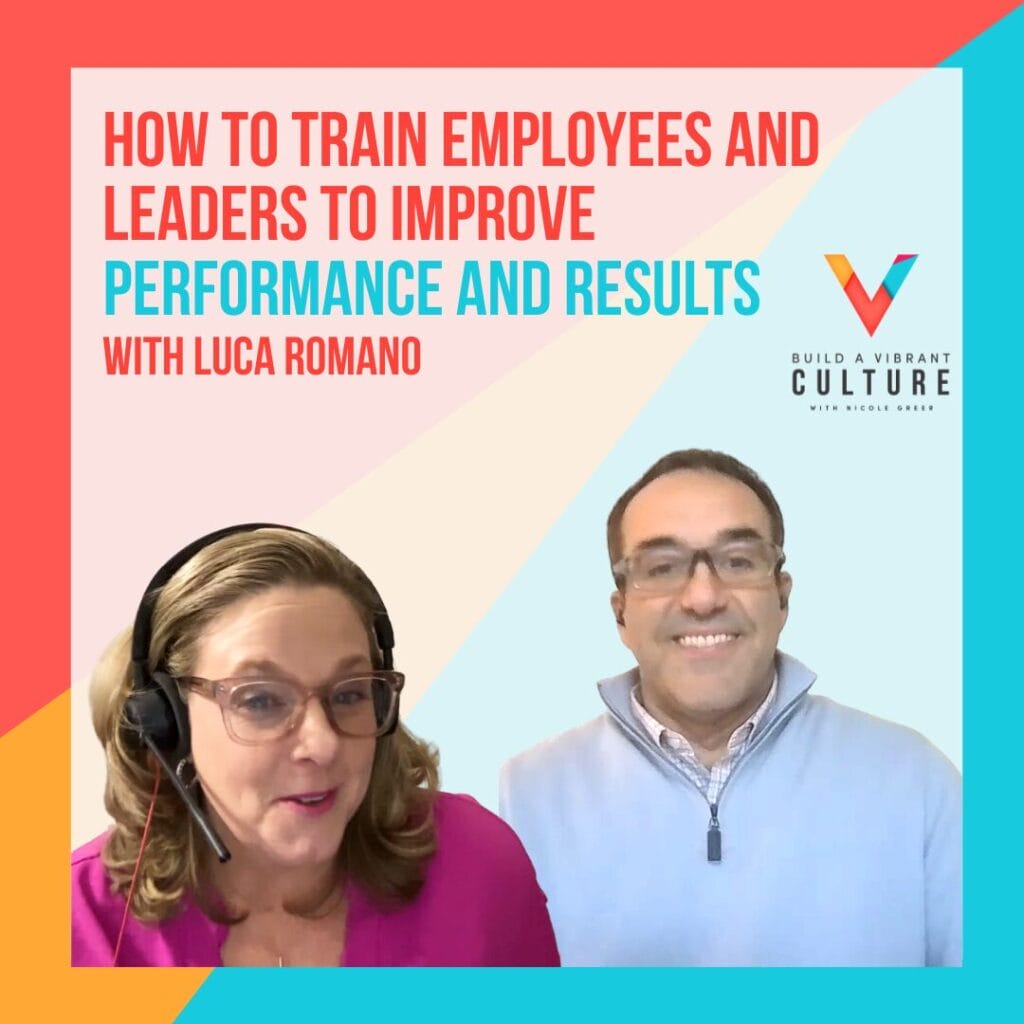
Most leaders know training matters, but they treat it as something you do to employees rather than something leaders and employees do together. On a recent episode of the Build a Vibrant Culture Podcast, Nicole Greer talked with manufacturing leader and executive coach Luca Romano about how bringing Nicole in to train employees and leaders side by side, using the TILT assessment and the SHINE methodology, helped him improve performance and results across his entire team. The outcome was measurable: his plant’s on-time delivery climbed from 51 percent to 91 percent in under two years.
Train Employees and Leaders Together to Improve Performance and Results
Luca, who has a background in engineering and operations leadership, learned early that training only works when leaders go through it alongside their teams. In previous roles, he had seen senior leaders mandate training they never attended themselves, and the results never stuck. When Nicole introduced the SHINE methodology and the TILT assessment to his organization, Luca made sure his entire leadership team, not just the floor staff, went through the same process. That decision became the foundation for everything that followed.
How the SHINE Methodology Builds Self-Assessment Into Leadership
SHINE stands for self-assessment, habit work, integrity work, next-right-step work, and energy work. Luca points to self-assessment as the piece that makes everything else possible. Before you can train anyone else to improve performance, he says, you have to understand your own triggers, your own energy, and what makes you the best version of yourself. Without that foundation, leaders end up asking employees to change behaviors they have not examined in themselves.
How the TILT Assessment Gives Teams a Shared Language
The TILT assessment gave Luca’s team something they had never had before: a shared vocabulary for naming behavior. Instead of vague feedback like “be less aggressive,” TILT identifies a desirable trait. It shows what it looks like when overused and when underused. That clarity let the team define core values and use a simple feedback structure called C3 to address misalignment directly.
One of the clearest examples Luca shares is training a newer manager through a difficult conversation with a long-tenured employee who wasn’t living up to the team’s values. The structure made the conversation feel mechanical rather than emotional, which gave both people the safety to have it. The underperforming employee chose to leave, and the role was backfilled with someone who fit the culture from day one.
From 51% to 91%: A Performance and Results Turnaround
The business impact of training employees and leaders together was measurable. Luca took over a factory operating at 51 percent on-time delivery. Within two years, using TILT, SHINE, and the EOS and Traction operating system together, that number climbed to 91 percent, and the team went from the worst-performing division in the company to the best. Luca attributes much of that change to redirecting wasted mental energy. Once leaders stopped spending hours worrying about how to broach difficult conversations, they redirected that energy toward moving projects forward.
Investing in Training Time Pays Off
A recurring theme in the conversation is the cost of skipping training to hit short-term deadlines. Luca makes the case that skipping a four-hour training session might save time today, but it guarantees the same problem resurfaces tomorrow. He also pushes back against the common fear that training an employee well enough to be certified elsewhere will cause them to leave. In his experience, investing in people is what keeps them, not what drives them away.
The Heart and Mind Framework TO TRAIN EMPLOYEES AND Leaders and Get Results
Luca concludes the conversation with what he calls the heart-and-mind partnership. The heart side is about managing your own energy and creating a workplace where people feel seen. The mind side is about providing structure: Core values, clear expectations, and frameworks like TILT and SHINE that make it obvious when something is out of alignment. For leaders looking to improve performance and results on their own teams, Luca’s advice is to train both sides at once. Self-assessment comes first, then structure, then the willingness to have the hard conversations that structure makes possible.
Connect with Luca Romano
You can find Luca Romano at his website: https://www.manufacturing-coach.com
Work With Nicole Greer & Vibrant Culture
Learn more about Vibrant Culture & how Nicole Greer can help your team succeed (like she did with Luca)
🔹 Explore the TILT Assessment: https://vibrantculture.com/product-category/tilt-365/
🔹 Download the Speaker Packet: https://vibrantculture.com/speaker-kit-request/
🔹 Explore the Employee Training Catalog: https://vibrantculture.com/catalog-request/

