
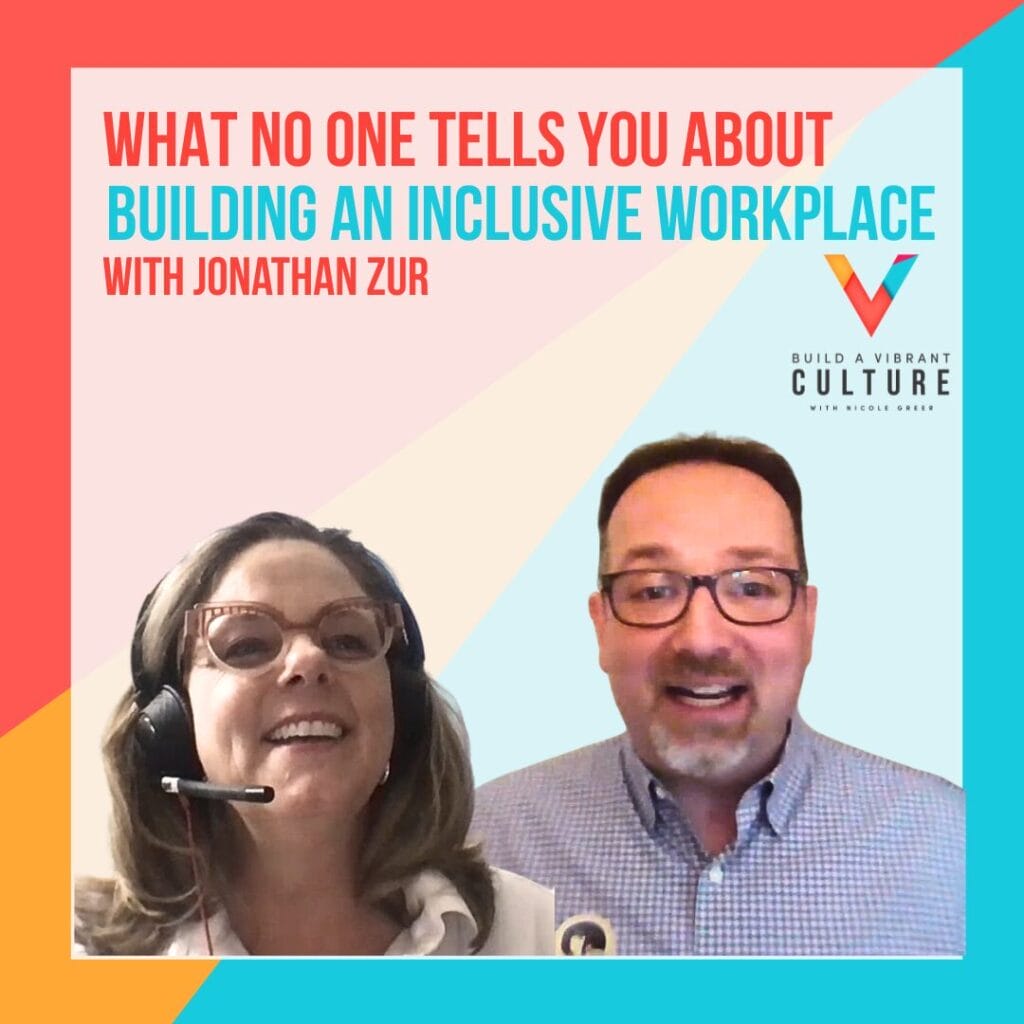
No one tells you that when you build an inclusive workplace, the words diversity, equity, and inclusion are not interchangeable. Jonathan Zur, president and CEO of the Virginia Center for Inclusive Communities, says that is part of the problem.
In this episode of the Build a Vibrant Culture Podcast, Nicole Greer sits down with Jonathan to unpack what these terms mean, why diversity without inclusion leads to dysfunction, and how organizations can move beyond one-time training to build an inclusive workplace and culture where everyone genuinely belongs.
Diversity Is Just the Starting Point for an inclusive workplace
Jonathan defines inclusion as accepting, respecting, and valuing all people. Diversity, on the other hand, is simply the presence of difference. Having two people of different backgrounds in a room creates diversity, but it does not automatically create a productive or healthy environment.
This distinction matters because many organizations stop at diversity. They focus on representation, hit a recruitment number, and consider the work done. Jonathan points to research from organizational behavior expert Nancy Adler showing that monocultural teams often report feeling more effective than they actually are, while diverse teams report more friction even when their results are objectively better. Sameness feels comfortable. It is not the same as performing well.
Without the work of inclusion, increased diversity can actually create more friction in the short term. That tension shows up as miscommunication, groupthink, and people holding back ideas because they are unsure how those ideas will be received. Jonathan offers a simple way to remember this: diversity minus inclusion equals dysfunction.
Equity Is Not About Giving Everyone the Same Thing
Of the three terms, equity may be the most misunderstood. Jonathan uses a definition from the Annie E. Casey Foundation: equity is the state, quality, or ideal of being just, impartial, and fair.
The key insight is that fairness does not mean treating everyone identically. Jonathan shares a personal example from childhood in which he and his younger sister needed different things from their parents at different ages. Giving them the exact same treatment would actually have been unfair because their needs were different.
He translates this into a workplace example around bereavement leave policies. Many organizations have a standard list of family members and a fixed number of days off, copied year after year from a template. An equity lens asks a different question: who decided which family relationships count, and who decided how long someone needs to grieve? Different employees, shaped by different cultures and family structures, may need different things. An inclusive workplace with equity means building policies that are flexible enough to meet people where they are, rather than assuming one model fits everyone.
The Three P’s: Pathways, Programs, and Policies
So how does an organization actually create an inclusive workplace rather than just talk about it? Jonathan offers a practical framework built around three areas.
Pathways cover recruitment and retention. How do people get into your organization, and how do you ensure they have real opportunities to grow once they arrive?
Programs cover the culture you build day to day. This includes professional development, mentoring, and affinity groups that help people co-create a culture that works for everyone, not just the majority.
Policies cover the structural level. This means examining your personnel manual, your vendor relationships, and your compensation practices to ensure equity is built into the systems people actually live inside, not just stated as a value.
Jonathan is candid that many DEI efforts fail because they only address one of these three areas. A single training builds shared vocabulary but does not change recruitment. A new policy gets written but is never reinforced through ongoing programming. Real progress requires working at all three levels together, and committing to it as an ongoing part of how the organization operates rather than a one-time initiative.
Why Change Management Belongs in the DEI Conversation
One of the more unexpected threads in this conversation is the link between an inclusive workplace and change management. Jonathan references William Bridges’ framework on transitions, which distinguishes between change, which happens to everyone at the same time, and transition, which is experienced differently by each person.
Some employees will be energized by a shift toward a more inclusive workplace. Others will feel like something familiar and comfortable is being taken away. Both reactions are valid, and both are happening in the same room at the same time. Jonathan argues that organizations need to build in space for people to process what they are losing, sit with the ambiguity of what is changing, and eventually move toward a new beginning, rather than expecting everyone to adjust on the same timeline.
This is also why “tolerance for ambiguity” comes up repeatedly in the episode. Nicole notes that in her own change readiness assessments, this trait consistently scores the lowest among leaders. Inclusion work, by its nature, requires sitting with discomfort and unresolved questions longer than most leaders are used to.
Leading With Wonder Instead of Judgment
Perhaps the most practical takeaway from this conversation is Jonathan’s advice on how to actually talk about these issues without people walking on eggshells. His suggestion: when you hear something unfamiliar or uncomfortable, respond with wonder instead of judgment.
Rather than immediately writing someone off for an unfamiliar viewpoint, Jonathan encourages leaders to get curious about why two people who work together or live in the same community have had such different experiences. This does not mean abandoning your own values. It means building enough trust that people can make mistakes, learn, and stay in relationship with each other instead of cutting each other off.
He closes the conversation with a guiding principle borrowed from the disability rights movement: nothing about us without us. Any DEI strategy built in a closed room without input from the people it affects is unlikely to succeed. The organizations that get this right build trust and infrastructure before a crisis hits, not in the middle of one.
Who This Episode Is For
This conversation is for HR leaders, people managers, and business owners who want to move beyond surface-level diversity efforts and embed inclusion in the fabric of their organization’s operations. If your team has done a training or two but nothing has structurally changed since, this episode will give you a clearer framework for what comes next.
Connect with Jonathan Zur
You can find Jonathan at https://inclusiveva.org/
Work With Nicole Greer & Vibrant Culture
Ready to build a work culture where people thrive, communicate effectively, and do their best work?
🔹 Book Nicole to Speak at Your Next Event: vibrantculture.com/speaker-kit-request/
🔹 Explore Leadership Training & Coaching: vibrantculture.com/catalog-request/
🔹 Connect on LinkedIn: Nicole Greer
🔹 Speaking & Training Inquiries: [email protected]

